MTB terminology is the language riders use to talk on the trail: when someone says “take the chicken line and watch the landing after the drop,” everybody knows what to do. Because most of these words come from English, they sound like a secret code to beginners. In this MTB glossary I explain 32 terms we use every day on the trails of Bike Park Evolution, in the workshop and in training sessions.
In short:
- These mountain bike terms fall into four groups: trail elements, obstacles and jumps, riding technique, and the bike with its gear.
- A chicken line is always an easier, safer line around an obstacle, and there is no shame in using it.
- Drop, gap and table-top are three different kinds of jump: on a gap a short jump means a crash, on a table-top it doesn't.
- SAG is how far your suspension compresses under rider weight, and for most MTBs it is 20–30% of travel.
MTB Terminology: Trail Elements
Singletrack
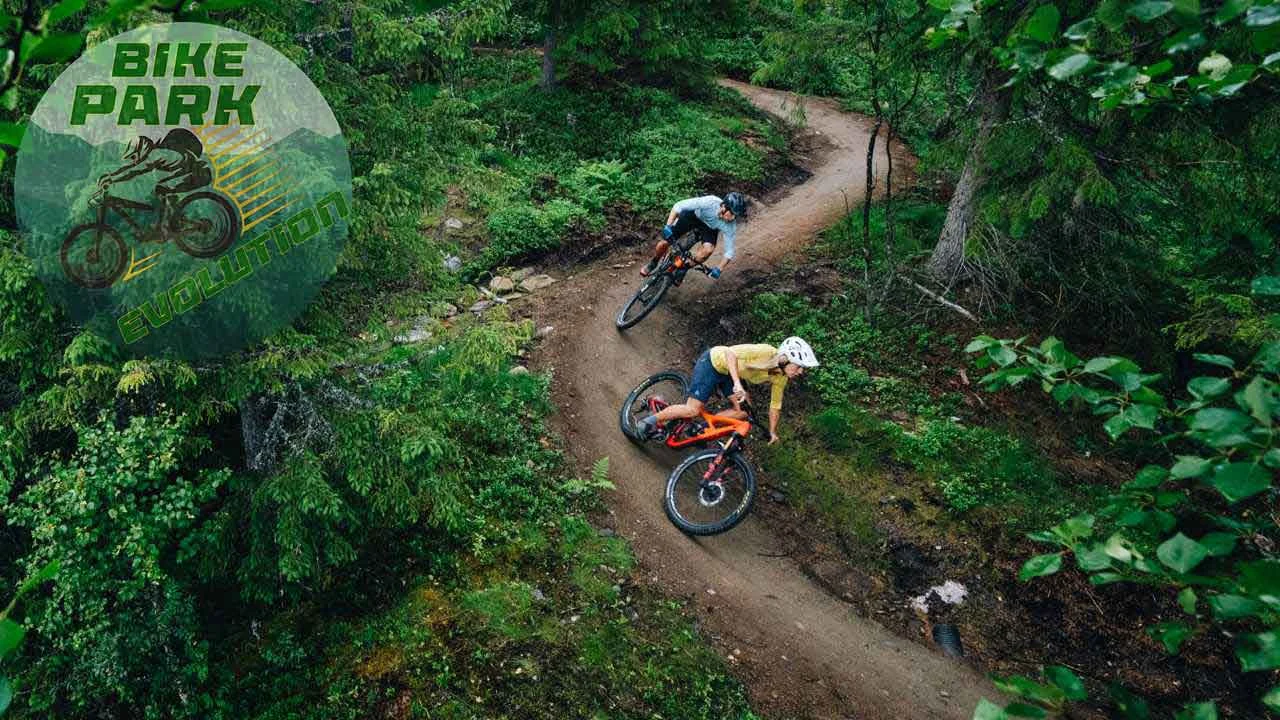
A narrow trail the width of one bike, ridden in single file. Most enduro and XC trails in our area are singletracks.
Doubletrack
A wider trail or dirt road with two tracks, usually a forest road. You can ride side by side on it and overtake.
Flow trail
A trail designed to be ridden in rhythm, without sudden braking: berms, rollers and jumps follow one another and carry your speed.
Berm
A banked corner with a raised outer edge. It lets you carry more speed through the turn with more stability, because the bank keeps you on your line. For the full cornering drill, see our berm riding technique protocol.
Off-camber
A section of trail that slopes toward the outside of the turn. Tires slide more easily, so you ride calmly with your weight on the outside pedal.
Switchback
A sharp turn of almost 180 degrees, typical of steep slopes. It demands a precise line and speed control before you enter.
Rock garden
A section covered with rocks of different sizes. You ride it in the attack position, looking ahead and without braking hard.
Root section
A part of the trail with prominent roots. Roots are very slippery when wet, so cross them as square as you can and don't brake on the root itself.
Technical section
A demanding stretch that calls for skill rather than power: a mix of rocks, roots, steep pitches and narrow passages.
North shore
Wooden structures on the trail: bridges, ramps and narrow planks. The name comes from the North Shore area near Vancouver, where they originated.
Pump track
A looped track of rollers and berms that you ride without pedaling, just by pumping with your body. It is an excellent technique workout.

Obstacles and Jumps
Drop
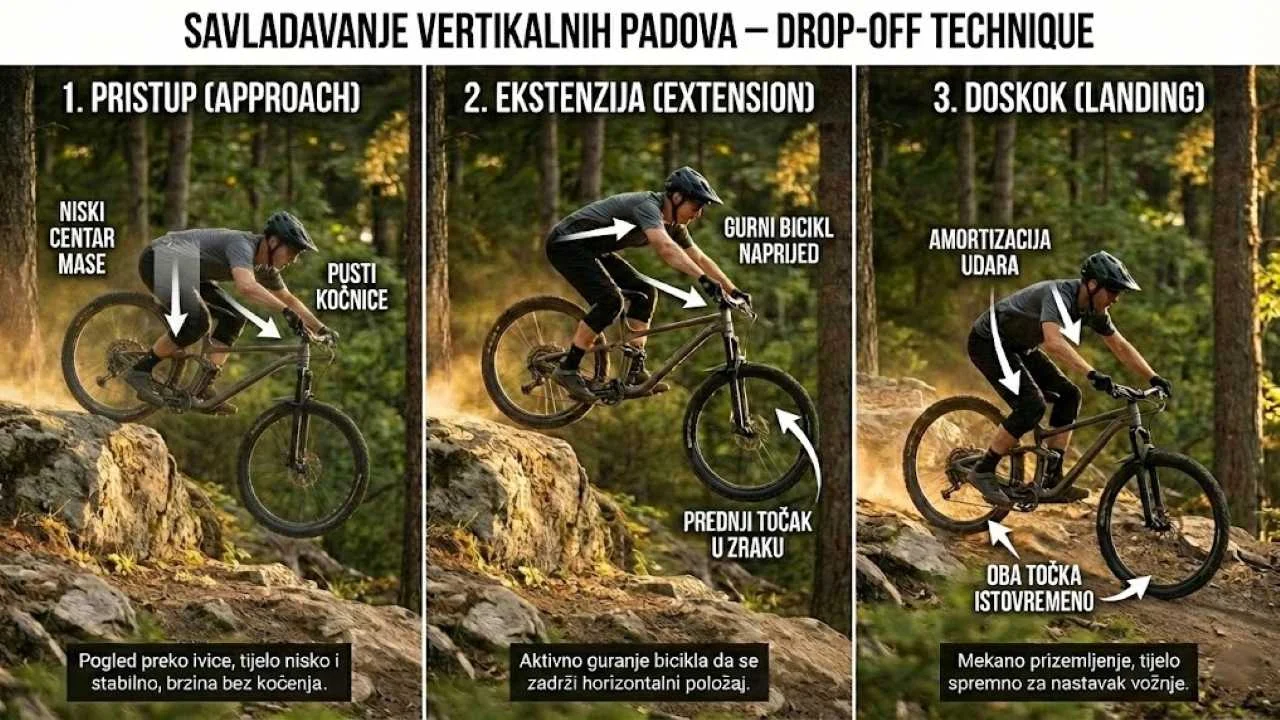
A vertical step down from an edge, rock or ramp to a lower level. On a drop you don't jump upward; you lower the bike in a controlled way while lightly lifting the front wheel. We cover it step by step in our drop-off technique guide.
Gap
A jump over an empty space between the takeoff and the landing. If you don't clear the whole distance, you fall into the hole, which makes a gap more dangerous than a table-top.
Table-top
A jump where the space between takeoff and landing is flat and filled in. If you come up short, you simply land on the flat part. It is ideal for learning to jump.
Kicker
A short, steep takeoff that throws the bike upward abruptly. It requires a calm body and correct position, because it easily “kicks” the rear wheel out.
Step-up
A jump from a lower to a higher level, where the landing is above the takeoff. It needs more speed than it looks.
Step-down
A jump from a higher to a lower level, where the landing is below the takeoff. The landing is softer, but it's easy to overshoot.
Rollover
An obstacle you can roll over without jumping, with both wheels staying on the ground. It is often a rock or a rocky step.
Landing
The part of a jump or drop where you touch down. A good landing slopes down the trail, so touchdown is smooth.
Chicken line
An easier line that bypasses a hard obstacle. Every well-built trail has one, and you use it until you can handle the obstacle with technique. It is also called a “B-line.”
Riding Technique: Terms You'll Hear in Training
Line choice
One of the most important concepts in MTB terminology: choosing your line through a trail or obstacle. The same section can be easy or hard depending on the line you pick.
Attack position
The basic stance for descending: pedals level, knees and elbows bent, weight over the bottom bracket. More in the protocol Attack Position and Braking Technique.
Manual
Riding on the rear wheel without pedaling by shifting your weight back. More in the protocol Manual – the King of MTB Skills.
Bunny hop
A jump with both wheels off flat ground over an obstacle, without a ramp. See the Bunny hop protocol.
Pumping
Gaining speed without pedaling by pushing the bike into the downslopes of rollers. See the pumping technique.
Scrubbing
Pushing the bike sideways during a jump so the flight is lower and faster. An advanced technique for fast riders.
Hike-a-bike
A part of the route that is too steep or too difficult to ride, so you push or carry the bike. On mountain tours it is completely normal.
Bike and Gear: Basic MTB Terminology
Travel
In MTB terminology, travel tells you how many millimeters your suspension can compress. XC bikes have about 100–120 mm, enduro 150–170 mm, and downhill 200 mm and more.
SAG
The suspension sag when you sit on the bike in full riding gear. For most MTBs it is 20–30% of travel. Read how to set it in our guide to MTB suspension tuning.
Dropper post
A telescopic seatpost that you lower and raise with a lever on the handlebar while riding. On descents it gives your body room to move.
Hardtail and full suspension
A hardtail has only a front fork, while a full suspension bike also has a rear shock. We described the differences in the article full suspension vs hardtail.
Tubeless
A tire system without an inner tube, with liquid sealant that closes small punctures on its own. It allows lower pressure and fewer flats. Here is how to set up tubeless tires step by step.
Where to See These Elements in Person
You can try most of the elements from this glossary on the MTB trails of Bike Park Evolution on Ilinjača. For a more detailed explanation with pictures of every feature, see the page MTB trail features, and for the map and trail ratings visit Trailforks. MTB terminology is learned fastest on the trail itself, so feel free to join one of our rides.
Frequently Asked Questions
What does chicken line mean in MTB?
A chicken line is an easier line that bypasses a hard obstacle on the trail. Anyone who hasn't mastered the obstacle yet can use it, and it is a smart choice, not a cowardly one.
What is the difference between a drop and a gap?
A drop is a vertical step down to a lower level, with no empty space. A gap is a jump over empty space between the takeoff and the landing, so if you don't clear it, you fall into the hole.
What is SAG on a bike?
SAG is the suspension sag when you sit on the bike in full riding gear. For most MTBs it is 20 to 30 percent of total travel.