Protocol: Long-Term Athlete Development (LTAD) in Cycling
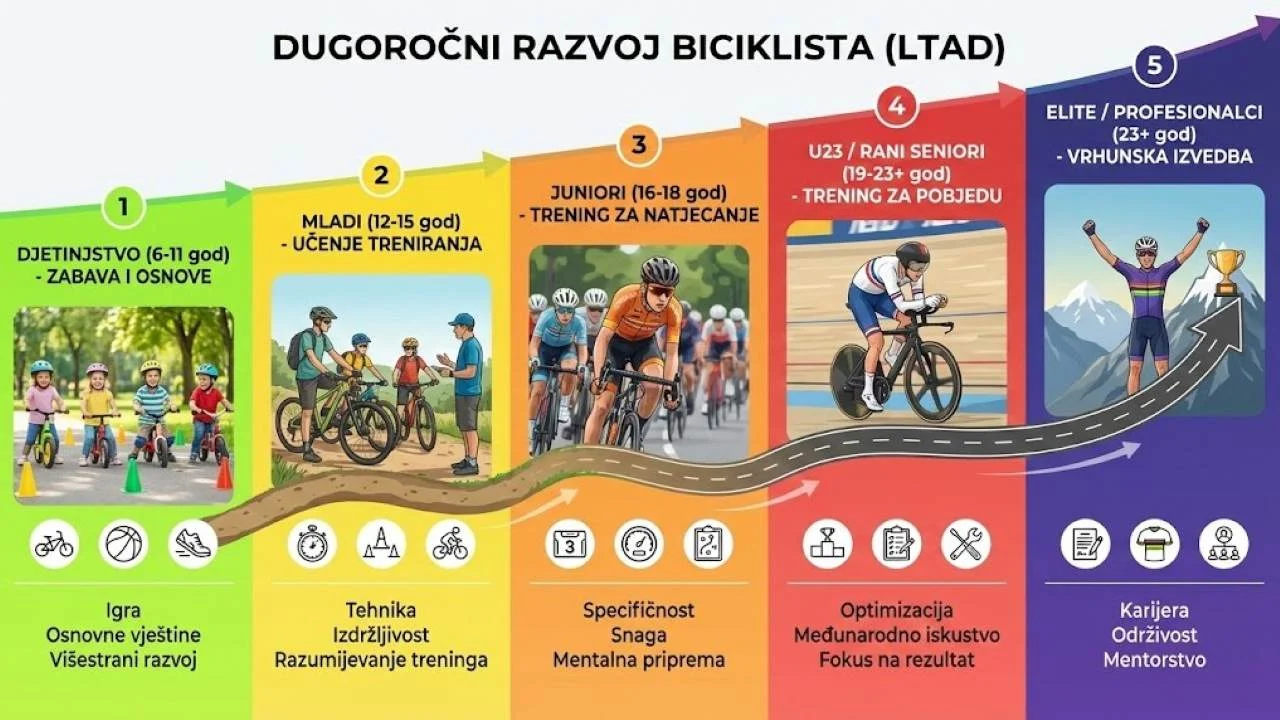
Long-term athlete development starts with one simple idea: "A 7-year-old is not a small adult."
Mission: The right training at the right time. A child's actual stage of development dictates the training, not a parent's ambition.
Goal: To apply the principles of long-term athlete development and raise a complete person – an athlete who is skilled, healthy and loves sport for life.
Active Start (ages 4 – 7)
Motto: "Play is the most serious form of training."
In the first phase of the long-term athlete development model, a child's brain develops at an incredible speed. The goal is not fitness, but a feel for movement and balance.
Training protocol (through play)
| Activity | Exercise description | Goal |
|---|---|---|
| Bike Tag | Kids ride in a limited space and try to "catch" each other. | Looking around, anticipating movement. |
| Agility Course | Riding between cones, over planks and under a tape. | Skilful steering. |
| Snail Races | Who can reach the finish line the slowest without putting a foot down? | Balance control at a standstill. |
Learn to Train (ages 8 – 12)
Motto: "Skill before volume."
This is the "Golden Age" for learning motor skills within a long-term athlete development system. Because the brain learns so quickly at this age, skills mastered in this period stay for good. The focus is on agility and speed.
Train to Train / Compete (ages 13 – 18)
Motto: "We build the engine."
Puberty arrives. The body changes and gets stronger, allowing big gains in strength and fitness. Now we introduce a more serious training plan as part of long-term athlete development for young riders.
| Component | Training content |
|---|---|
| Planning | Introducing weekly schedules of work and rest. Learning that you can't train hard every day. |
| Intervals | Training to a plan: specific intensity work (under a coach's supervision). |
| Tactics | Drafting (in a group), reading the race, attacking, fueling during the race. |
Active for Life (19+ years)
Motto: "Performance through health."
Focus on intensity during the week, volume on weekends.
Weekend PlanFocus on recovery. Needs 2x more time for muscle regeneration (reducing sarcopenia).
Recovery ProtocolModerate riding to reduce stress and manage weight.
Training Plan5. The role of parents in a young rider's development
Parents play a key role in the success of long-term athlete development (LTAD). Your job is not to be the coach, but to be the biggest supporter.
- Be patient: Progress is not linear. Plateaus are a normal part of the process.
- Praise effort, not results: Instead of "Well done for winning", say "Great job, I saw how hard you worked on that climb". This builds a growth mindset.
- Encourage variety: Don't push your child to only ride a bike. Swimming, running or hiking will make them a better cyclist in the long run.
Why do we insist on this model? (The science)
The statistics are dismal: 70% of children quit sport by age 13 because of an early focus on results. Our solution: a child who plays stays in sport.
Biology gives us limited time: ages 8-11 are best for motor skills, 13-16 for endurance. If we train endurance instead of skill at age 10, we have missed the opportunity.
Wide base = high peak. An athlete with excellent technique (built in childhood) can easily add strength. One with good fitness but poor technique will sooner or later hit a ceiling.