Technical Tips · Compatibility
MTB standards:
axles, bottom bracket, headset and brakes
MTB standards decide what fits your bike and what doesn't. A guide to the most important ones: axle spacing (Boost and Super Boost), bottom bracket standards, headset standards, brake mount standards and freehub bodies, with exact measurements and designations.
Written by Marko Ristivojević, Master Bike Mechanic
In short
What are MTB standards? Standards are agreed measurements and designations that define how bike parts fit together: rear hub axle spacing, bottom bracket shell width and diameter, head tube and fork steerer diameter (headset), brake mount spacing and freehub body type. Parts with the same job but a different standard can't be swapped without adapters, so measure before you buy.
Rear hub spacing
142×12 mm or 148×12 mm (Boost)
BB shell
68/73 mm threaded, 86.5/91.5 mm press-fit
Headset code
e.g. ZS44/28.6 | ZS56/40
Brake mount
IS 51 mm, Post Mount 74 mm
Author: Marko Ristivojević, Master Bike Mechanic · BK MTB Evolution, East Sarajevo
Why MTB standards matter
One of the most common questions in workshops is: will this part fit my bike? The answer depends on a few measurements that take five minutes to check, and a wrong purchase costs far more than measuring. The MTB standards here come in the order they show up most often: axles (Boost and Super Boost), bottom bracket standards, headset standards, brake mount standards and freehub.
If you can't identify a part with confidence, Evolution Bicycle Service in East Sarajevo can help determine the standard before you buy.
Axles and hub spacing: Boost and Super Boost
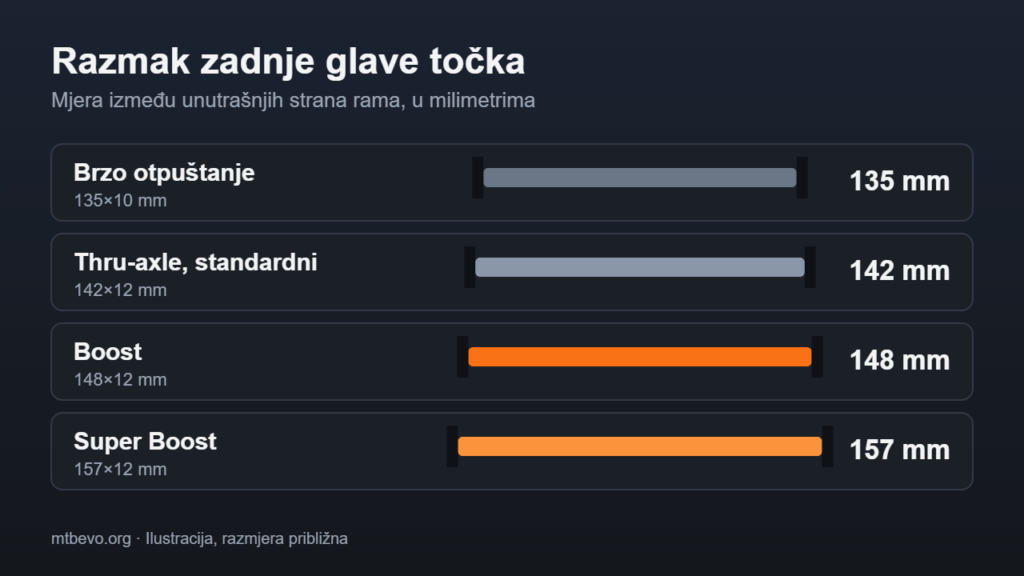
Older standards. Quick release: 100×9 mm front and 135×10 mm rear. Non-Boost thru-axle: 100×15 mm front and 142×12 mm rear.
Boost. 110×15 mm front and 148×12 mm rear. The wider spacing leaves room for wider tyres and a stiffer wheel, but it is incompatible with older standards: a 142 mm wheel won't fit a 148 mm frame and vice versa.
Super Boost. 110×15 mm front and 157×12 mm rear. It is not the same as 157 mm on downhill bikes: hub geometry and rotor position differ, so wheels are not interchangeable. An axle of the same spacing also won't necessarily fit every brand, because frame end shape, thread pitch and axle length vary.
Bottom bracket standards: threaded, press-fit and T47
Threaded (BSA/ISO). 73 mm shell on MTBs (68 mm on road bikes) and 1.37" × 24 TPI thread (34.8 mm). The easiest to service, because the cups simply screw into the thread.
Press-fit (BB86/92, PF30, BB30). The cups are pressed into the shell. BB86/92 has a shell width of 86.5 mm (road) or 91.5 mm (MTB, PF92) and a 41 mm diameter. PF30 has a 46 mm diameter and BB30 42 mm, both in 68 or 73 mm widths.
T47. A larger-diameter threaded standard: M47×1 thread, 46 mm diameter and 68 or 73 mm width. Typically used with 30 mm spindle cranks.
Crank spindle. Shimano Hollowtech II uses 24 mm, SRAM GXP 24/22 mm, SRAM DUB about 29 mm, and BB30, PF30, BBright and T47 systems 30 mm. DUB fits threaded, PF86/92, BB30 and PF30 (73 mm) shells. 24 mm cranks can be used on 30 mm systems with adapters and spacers, but this may reduce stiffness and reliability.
Headset standards: ZS, IS and tapered steerers
How to read the code. The designation (S.H.I.S.) has two parts, for the upper and lower cup. Example: ZS44/28.6 | ZS56/40. The first number is the inner diameter of the head tube opening that takes the cup or bearing, and the second is the steerer diameter: 28.6 mm (1 1/8") at the top and 40 mm for tapered, or 30 mm for a straight steerer.
Types. EC (External Cup) has cups pressed into the tube with the wider part left outside. ZS (Zero Stack) sits mostly inside the head tube, so only a narrow ring shows. IS (Integrated) has bearings directly in the tube, without cups, for example IS42/28.6 | IS52/40.
Tapered and straight steerer. A tapered fork steerer (1 1/8" to 1.5") needs a headset with a 40 mm lower bearing. A straight 1 1/8" steerer can fit a tapered headset with a reducing crown race.
How to measure. Use calipers to measure the inner diameter of the head tube (with the old headset removed) and the steerer diameter. First check the frame and fork manufacturer's data, as they often list the exact headset code.
Brake mount standards: IS, Post Mount and Flat Mount
Brake mount. IS (International Standard) has a hole spacing of 51 mm, Post Mount 74 mm, and Flat Mount 70 mm on the fork and 34 mm on the frame. A Post Mount caliper goes onto an IS mount through an IS adapter.
Rotor size. The most common rotors are 140, 160, 180, 200 and 203 mm. A rotor larger than the mount was designed for needs an adapter of the matching size. Example from SRAM's table: on an IS mount made for a 160 mm rotor, a 180 mm rotor goes with a 20 IS adapter. Always check the exact adapter in the brake manufacturer's table.
Bolts and rotor. On Post Mount calipers the bolt should engage 9–13 mm of thread, and on Flat Mount 5–7 mm (according to SRAM). The rotor mounts to the hub with six bolts or a Centerlock lockring, so check what your hub supports before buying.
Freehub and cassette: HG, XD and Micro Spline
Shimano HG. The most widespread freehub. It takes 8- to 11-speed Shimano MTB cassettes with a smallest cog of at least 11 teeth, as well as HG-compatible cassettes from other brands up to 12 speeds (except SRAM XD and XDR).
Shimano Micro Spline. For Shimano 12-speed MTB and gravel cassettes with a 10-tooth smallest cog. It has 23 splines and is not compatible with HG, XD or XDR cassettes.
SRAM XD and XDR. XD is for SRAM 11- and 12-speed MTB cassettes (smallest cog 10 teeth or fewer). XDR is for 12- and 13-speed road and gravel cassettes, and its freehub body is 1.85 mm longer than XD. An XD cassette fits XDR with a 1.85 mm spacer. Many hubs have a swappable freehub body, but check the manufacturer's instructions.
The golden rule from our workshop: before you click "buy" on any drivetrain, wheel or steering component, grab a caliper or send a photo of the markings on your existing parts to the workshop. It is much cheaper and faster to check three measurements on the bench than to return the wrong part or repair a damaged thread on the frame.
Pro tip: measure before you buy, don't assume from the bike model. The most common mistakes are mixing up 142 and 148 mm rear spacing, a 24 mm crank on a 30 mm system without an adapter, the wrong headset code (ZS44 and IS42 are not interchangeable) and an XD cassette on an HG freehub. If you're not sure, Evolution Bicycle Service can help determine the standard. Measurement sources: BikeRadar (axles), BikeRadar (bottom bracket), Bike-Components (headset), Bike-Components (freehub) and SRAM (brake mounts).
FAQ: Frequently asked questions
Does a Boost wheel fit a non-Boost frame?
Not without modification. The rear hub spacing is different (142 mm vs 148 mm), so the wheel doesn't seat in the frame. Modification is complex and should be assessed by a workshop or the wheel manufacturer.
How do I know which bottom bracket I have?
Measure the shell width (68 or 73 mm for threaded, press-fit 30 and T47; 86.5 or 91.5 mm for BB86/92) and the opening diameter or thread. Also check the crank spindle: 24 mm, about 29 mm (DUB) or 30 mm. Bottom bracket servicing is covered in the bottom bracket service guide.
What is the difference between ZS44 and IS42 headsets?
ZS has cups that mostly sit inside the head tube, while IS has bearings directly in the tube. They also differ in opening diameter (44 mm for ZS44, 42 mm for IS42), so they are not interchangeable.
Can I fit an XD cassette on a Shimano HG freehub?
No. An XD cassette has a smallest cog of 10 teeth or fewer and needs an XD freehub. On many hubs the freehub body can be swapped, so check the hub manufacturer's instructions.