Tech tips · Brakes
Bike disc brakes
How to center them and stop the rubbing
A rotor rubbing on the pads is usually a sign of a poorly aligned caliper. You can center disc brakes yourself with just a hex key, and if that doesn't work, the Evolution workshop in Istočno Sarajevo can true the rotor and straighten the mounts.
Written by Marko Ristivojević, Master Bike Mechanic
In short
To center disc brakes, you position the caliper so the rotor sits exactly in the middle between the two brake pads. The process is the same for front and rear brakes. Rubbing usually means the caliper is poorly centered, but the cause can also be a wheel that isn't seated properly or a bent rotor.
Tools
Hex key, usually 5 mm
Procedure
Same for front and rear brake
Check first
Wheel, pads and rotor
Needs a workshop
When the frame mounts are bent (DT-5.2)
Author: Marko Ristivojević, Master Bike Mechanic · BK MTB Evolution, Istočno Sarajevo
How to center disc brakes on a bike and get rid of the squeal
Disc brake rubbing is one of the most common problems riders run into. Even the slightest contact between rotor and pads may not slow you down much, but it's annoying and can signal uneven wear.
This guide helps you with brake caliper alignment on a hydraulic brake of any brand. If the brakes still make noise afterwards, check out the guide to squeaky disc brakes.
Diagnosis: why disc brake rubbing happens
Before you pick up a tool, find the real cause. A poorly centered caliper is the most common culprit, but rubbing can also come from a wheel that isn't seated properly in the frame or fork.
Wheel seating – check that the axle is fully inside the dropouts. Sometimes it's enough to loosen and re-tighten the quick release while the bike stands on the ground.
Worn pads – if the brakes are noisy, check the thickness of the pad material. Our guide on which pads to choose can help.
Bent rotor – spin the wheel and watch the rotor through the caliper. If it wobbles, brake caliper alignment alone won't fix the problem for good.

Step by step: centering the caliper
The procedure is the same for front and rear brakes. The goal is to have the rotor sit exactly in the middle between the two brake pads.
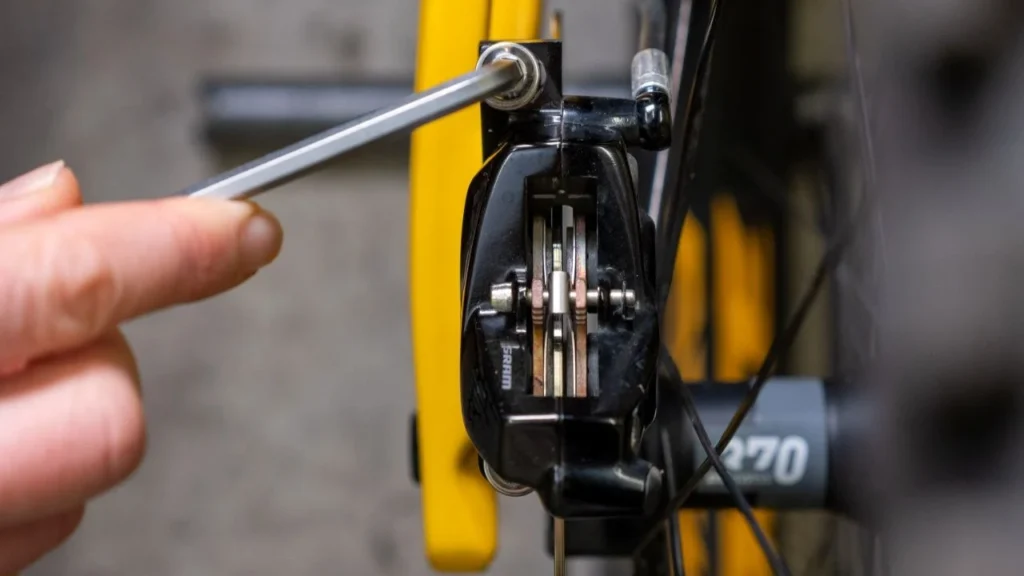
Loosen the bolts – use a hex key (usually 5 mm) to loosen the two bolts that hold the caliper to the frame or fork, just enough that you can nudge the caliper with your fingers.
Center by squeezing – with the caliper loose, pump the lever a few times so the pistons extend, then squeeze it firmly and hold. The pressure makes the caliper align itself with the rotor.
Lock it in – while holding the lever, tighten the bolts alternately (a little on the top one, a little on the bottom) so the caliper doesn't shift.

Fine-tuning and specific systems
If the brakes still lightly touch the rotor after the basic procedure, you need to fine-tune by eye. Look at a light source through the caliper and make small corrections until you see an equal gap on both sides of the rotor. This kind of bike brake adjustment takes a bit of patience.
Conical washers – some models (older Avid/SRAM) use sets of conical washers to adjust the caliper angle. Don't add or remove them unless they came from the factory that way, as you'll upset how the pads sit against the rotor.
Advanced problem – DT-5.2: if you've tried everything and the caliper still sits crooked, the mounts on the frame may not be flat. That calls for the professional Park Tool DT-5.2 facing tool, and we do this job only in the workshop.
External resources and service manuals
Park Tool – Alignment Guide (reference guide)
Shimano SI Manuals (official Shimano documentation)
Disc brake FAQ
What should I do if my disc brakes still squeal after centering?
Squealing is usually a sign of contamination. Clean the rotor with isopropyl alcohol, and if the pads have soaked up oil, they'll need to be burned off or replaced.
Can I touch the rotor with my fingers?
Absolutely not. Natural oil from your fingers can contaminate the rotor, which drastically reduces braking power and causes unbearable noise.
When do I need the professional DT-5.2 tool?
When the mounts on the frame are bent, so the caliper still sits crooked relative to the rotor after all the steps. Facing the mounts is done only in the workshop.