Technical tips · Bearings
Bike hub bearings
loose balls, retainers and cartridge bearings
How freely a wheel spins depends on its hub bearings. Learn how loose balls in a cup, a retainer ring with balls and a cartridge bearing differ, how to tell which one is in your hub, and when it needs servicing or replacing.
By Marko Ristivojević, Master Bike Mechanic
In short
What are hub bearings? They are the parts that let a wheel rotate around its axle. There are three designs: loose balls in a cup, a retainer (a ring with balls) and a cartridge bearing in a housing. Balls and retainers are cleaned, greased and adjusted, while a cartridge bearing is replaced once it turns rough or develops play.
Three designs
Loose balls, retainer, cartridge bearing
What you can do yourself
Check play and roughness, clean and grease the balls, adjust the cone
Bearing code
6902 means 15 × 28 × 7 mm (inner diameter × outer diameter × width)
Leave it to the workshop
Pressing out and pressing in cartridge bearings, damaged seats and cups
Author: Marko Ristivojević, Master Bike Mechanic · BK MTB Evolution, Istočno Sarajevo
Why hub bearings are worth watching
The hub is one of the most heavily loaded places on a bike, and its bearings are constantly exposed to water, mud and side loads. A worn bearing rarely squeaks: more often it quietly wears the axle and the seat, so the repair later takes longer and costs more than regular service.
This guide covers all three systems, explains how bearing codes are read and what is done during service. When you need tools or experience, there is wheel service at Evolution Bike Service in East Sarajevo.
Bike hub bearings: loose balls, retainer ring and cartridge bearings
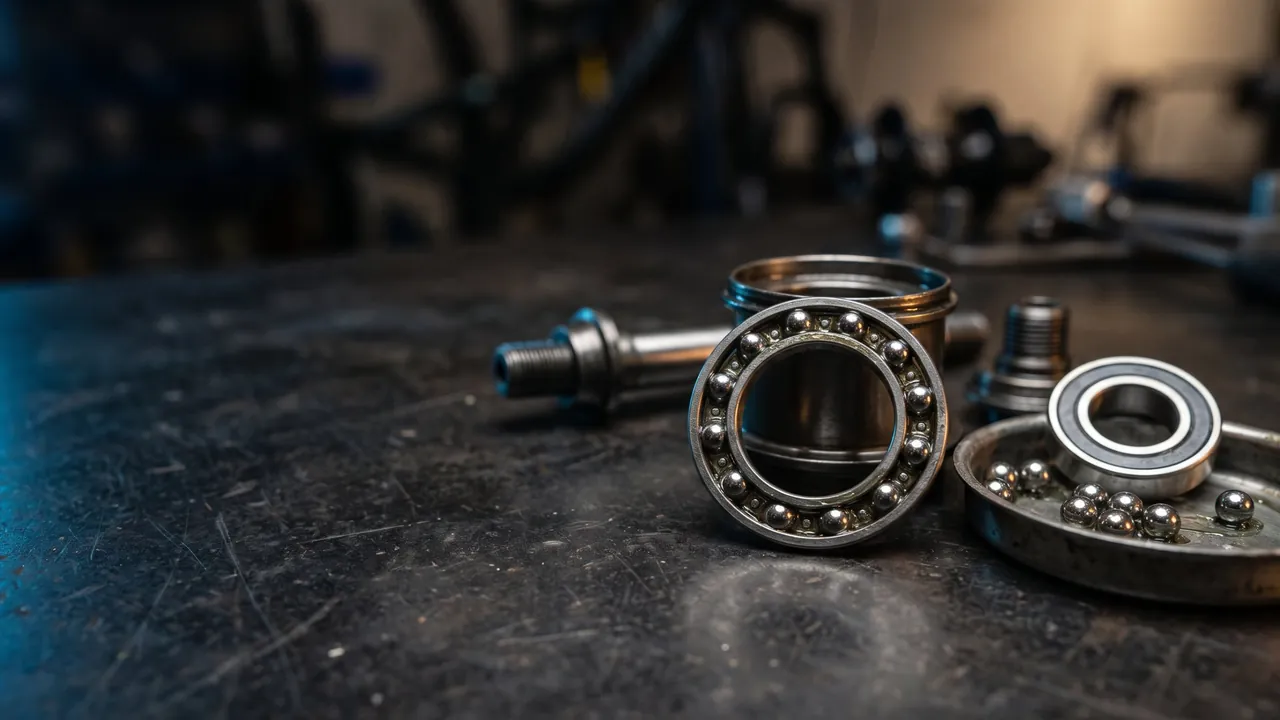
Loose balls in a cup. In a cup-and-cone system the balls sit loose in a cup and rest against a cone on the axle. There is no ring: balls are placed one by one, and play is set with the cone and lock nut.
Retainer. A ring (cage) with pre-spaced balls that goes into the same cup-and-cone system. All balls go in at once and at the correct spacing, and when replacing you swap the whole retainer.
Cartridge bearing. A sealed bearing with an inner and outer race, balls and seals, pressed into a seat in the hub. It cannot be adjusted, and when worn the whole bearing is replaced. Cartridge bearings are marked with a code, for example 6902-2RS.
How to identify the bearings in your hub
Look at the axle and nuts. If you see a cone, lock nut and washers on the outside, the hub is cup-and-cone. If the axle is smooth and you can see bearing seals in the hub, it uses cartridge bearings.
Read the code on the bearing. The code is printed on the outer race of a cartridge bearing, for example 6902-2RS. 2RS means rubber seals on both sides, ZZ means metal shields.
Reading the dimensions. The last two digits of the code give the inner diameter: 00 is 10 mm, 01 is 12, 02 is 15, 03 is 17, and from 04 upwards the number is multiplied by 5. So 6902 measures 15 × 28 × 7 mm, 6802 is 15 × 24 × 5 and 6904 is 20 × 37 × 9.
Measure with calipers. If the code is unreadable, remove the bearing and measure the inner diameter, outer diameter and width. For loose balls, measure an old ball (most often 3/16 or 1/4 inch, i.e. 4.76 and 6.35 mm) and count them.
Signs of worn hub bearings
Rough rotation. Remove the wheel and spin the axle with your fingers. A bearing should run smoothly and quietly. Catching, a gritty feel or noise means damaged races or balls.
Play. Hold the axle and try to move it sideways relative to the wheel. In a cup-and-cone system small play is set out with the cone, while pronounced play in a cartridge bearing usually means replacement.
Corrosion and damaged balls. Dark, dull or pitted balls and rust in the cup show that water has entered the hub. Such balls are replaced, and a damaged cup usually cannot be repaired.
The noise is not always the bearing. Clicking and creaking often come from the skewer, cassette or quick release. Before replacing anything, read the guide on a squeaky MTB to rule out other causes.
Hub service: cleaning, grease and adjustment
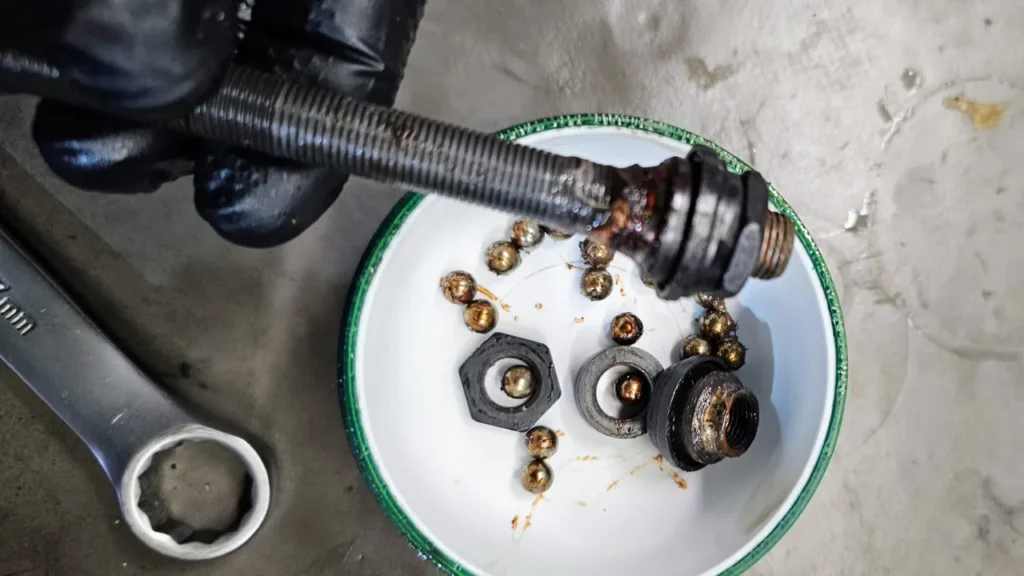
Cup and cone: clean, inspect, grease. Remove the cone, take out the balls, clean the cups and cones with degreaser and inspect the races. If they are smooth, put the balls back in fresh grease; if they are pitted, replace them. Set the cone so there is no play but the wheel still turns freely, and check with the axle clamped, because clamping adds load. Park Tool also describes the full procedure for this hub type in its hub overhaul guide.
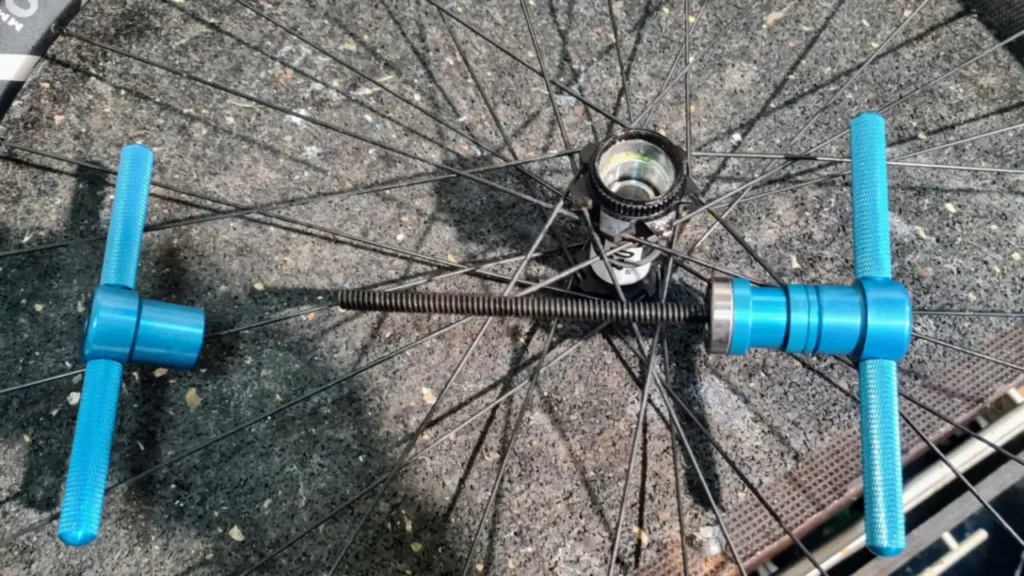
Cartridge bearing: press out and press in. The old bearing is driven out from the other side or pulled, and the new one is pressed in with a tool that pushes on the outer race, straight and all the way, never through the inner race. This needs a press-fit tool, so we do it in our wheel service.
Grease. Use bearing grease for balls and cups. Which grease and how much is explained in our guide to bike grease and oil. Do not force sealed cartridge bearings open and do not fill them to the top.
Replacing hub bearings: how to choose the right one
Exact dimensions and seals. When replacing hub bearings, use the old bearing as the sample: the same three dimensions and the same seal type (2RS or ZZ). A bearing that is only roughly the same size does not seat properly.
Quality over price. Unknown, cheapest bearings often have weaker seals and steel, so they give up sooner in mud and rain than bearings from known manufacturers.
Do not mix systems. A hub made for cartridge bearings cannot take loose balls, and the other way round. The exact type depends on the hub model, so check the model designation with the manufacturer before buying.
Pro tip: before you knock out the old bearing, photograph the direction of the seals and the order of washers and spacers. When reassembling, this prevents the most common mistake: a missing or reversed spacer.
FAQ: Frequently asked questions
What is a retainer in a bike hub?
A retainer is a ring (cage) with pre-spaced balls that goes into the hub cup. Unlike loose balls, which are placed one by one, a retainer is installed in one go.
Can I replace a cartridge bearing with loose balls?
No. A hub is built for one system: cups and cones for balls, or seats for cartridge bearings. Changing the system means a different hub.
How often should hub bearings be serviced?
Inspect cup-and-cone at least once a year, more often if you ride in mud and rain. With cartridge bearings, turn the axle now and then and check for play. We handle wheel work at Evolution Bike Service.
What does the code 6902-2RS on a bearing mean?
6902 is 15 × 28 × 7 mm (inner diameter × outer diameter × width), and 2RS means rubber seals on both sides of the bearing.