MTB creaks, knocks and squeaks are something every rider hears sooner or later: you're enjoying a ride on the trail, and out of nowhere an unfamiliar sound appears. Why an MTB creaks is one of the most common questions we get in our service center in East Sarajevo. What is specific to bicycles is that the sound doesn't necessarily come from the place where your ear detects it. Vibrations are easily transmitted through the hollow frame tubes and components, misleading you about the true source of the problem.
In this comprehensive guide, we will show you how to systematically diagnose the source of the sound, recognize the 20 most common causes, and know when it's safe to continue riding and when an urgent professional MTB bike service is needed.
In short from this guide:
- Sound location: Sound travels through the frame. Eliminating situations (e.g., pedaling vs. braking) is the fastest way to narrow down the search.
- Most common culprits: The bottom bracket, pedals, headset bearings, and saddle rails cause 80% of mysterious creaks.
- Safety first: Chain squeaking requires lubrication, but a "clack" from the fork or a knock from the frame require an immediate stop to the ride.
- Proper maintenance: Randomly spraying WD-40 is not a solution and can destroy the bearings.

MTB creaks: first find where the sound comes from
Before you grab your tools, it's important to do some basic diagnostics while riding. Ask yourself the following questions to narrow down the search:
- Does the sound occur while you're pedaling? If the answer is YES, the problem is most likely in the drivetrain (pedals, cranks, bottom bracket, chain, cassette).
- Does the sound occur when you brake? Focus on the disc rotors, brake pads, calipers, and possibly the headset.
- Does the sound occur only over bumps? The cause is often the headset (steering bearings), suspension bearings, axles, or even cables hitting the frame.
- Does the sound occur just when you move the bike? Check the wheels, hub bearings, disc brakes, and axle tightness.
- Does the sound occur only when you sit on the bike? A frequent and overlooked cause! The problem usually lies in the saddle itself, saddle rails, seat clamp, or seatpost.
20 most common causes of MTB creaks, knocks and squeaks
We have analyzed in detail the most common problems we encounter in our Evolution workshop. Here's what can cause those irritating sounds.
1. Dry or dirty pedals
Symptom: Creaking or squeaking that occurs exclusively under pedal load (usually at the same point of rotation).
What to do: Check the pedal thread, the bearing inside the pedal, and the contact between the pedal and the crank itself. Remove the pedals, clean the threads, apply mounting grease, and tighten to specification.
2. Loose pedals or cranks
Symptom: Deep cracking or crunching under heavy pressure (e.g., riding uphill).
What to do: A loose drivetrain should never be ignored, as riding with a loose crank can permanently damage the threads. Check the tightness of the bolts on the cranks.
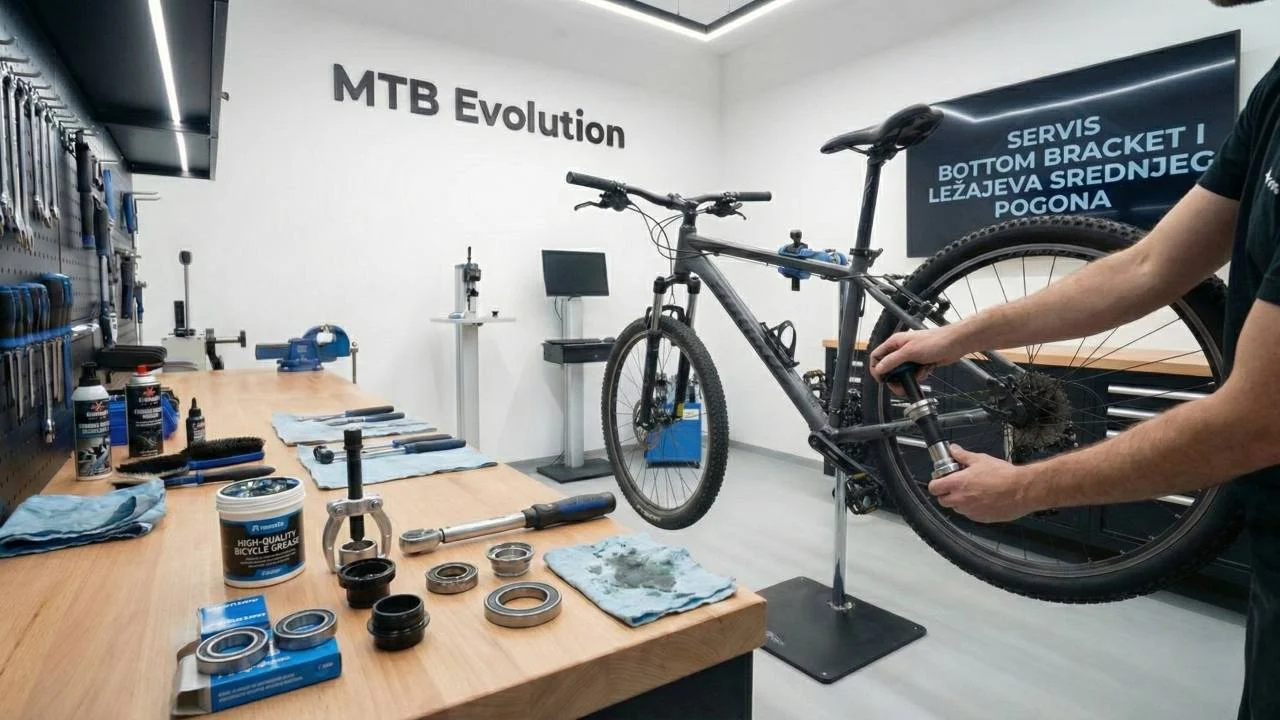
3. Worn or damaged Bottom Bracket
Symptom: Constant crunching that accompanies every pedal stroke, often accompanied by a "grinding" feeling underfoot.
What to do: Remove the chain from the front chainring and spin the cranks freely. If you feel resistance or roughness, the bottom bracket bearings are ripe for replacement. A worn BB is behind a large share of the MTB creaks we diagnose in the workshop.
4. Loose, dry, or worn chain
Symptom: Grinding sound, high-pitched squeaking ("chirping") like birds, vibrations, or skipping under load.
What to do: Proper chain maintenance is fundamental. Clean and lubricate the chain with dedicated oil. If the chain skips, be sure to check its wear with a chain tool.
5. Cassette or lockring not tightened correctly
Symptom: Cracking or metallic clicks coming from the rear wheel during a sudden change in load.
What to do: Check if the cassette has play on the freehub. It's necessary to tighten the lockring with a special tool to 40Nm.
6. Freehub (Rear hub body)
Symptom: Unusually loud cracking (different from the normal ratchet sound), skipping when pedaling forward, or resistance backward.
What to do: On MTB bikes, the freehub endures enormous forces. If it skips, it is necessary to open the system, clean the pawls, and apply adequate (thin) freehub grease.
7. Loose rear axle (Thru-Axle)
Symptom: Creaking from the rear triangle under heavy load (sprinting) or when going over roots.
What to do: Remove the axle, clean it, lightly grease the thread, and tighten it according to the manufacturer's recommendation.
8. Worn hub bearings
Symptom: Hum, a rough feeling that turns into vibrations through the frame, and noticeable play when you push the wheel left and right with your hand.
What to do: The bearings (cup and cone or cartridge) require servicing or complete replacement.
9. Spokes that are not properly tensioned
Symptom: A sharp "ping" or harp sound while riding, especially in corners or on technical climbs.
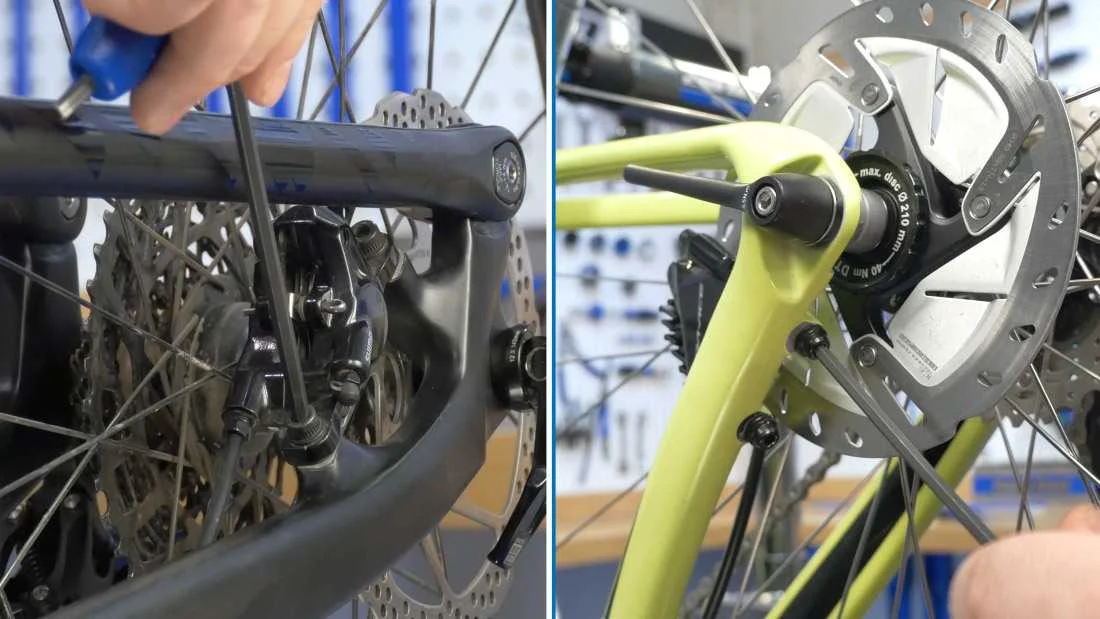
What to do: Check the evenness of the spoke tension by hand. If they are loose, the wheel must be trued and tensioned by an expert mechanic.
10. Disc rotor (Bent or loose discs)
Symptom: A rhythmic scraping ("shhh... shhh...") while riding, or squealing sounds after a long descent.
What to do: Check the rotor bolts. If the rotor is slightly bent, it can be straightened with a special tool. Never touch the braking surfaces with bare fingers!
11. Contaminated brake pads and calipers
Symptom: Terribly loud howling and squealing like a siren when braking, with a drastic loss of braking power.
What to do: Oil contamination (often from careless chain lubrication). It is necessary to degrease the rotors and replace the pads.
12. Headset – Steering bearings
Symptom: A dull thud or clear "clack" sound from the front when going over a pothole or when braking with the front brake.
What to do: Squeeze the front brake and rock the bike back and forth. If you feel play at the junction of the frame and fork, you need to loosen the stem and properly preload (tighten) the headset bolt on top of the top cap.
13. Stem and handlebar
Symptom: Cracking in the front when you pull hard on the handlebar on a climb.
What to do: Remove the front faceplate of the stem, clean the contact surfaces, and tighten the bolts in an "X" pattern using a torque wrench. Overtightening can break carbon!
14. Saddle and saddle rails (Very common!)
Symptom: A creak that sounds like it's coming from the drivetrain, but magically disappears when you stand up on the pedals.
What to do: Clean the joint where the seat rails connect to the seatpost. A drop of silicone spray on the joints under the seat often solves the "mysterious" problem. Saddle rails are the most underestimated source of MTB creaks.
15. Seatpost
Symptom: Similar to point 14, creaking when sitting that transmits through the entire frame.
What to do: Remove the seatpost. Clean it and the inside of the frame. For aluminum, apply a layer of grease, and for carbon, you MUST use carbon friction paste.
16. Dropper post
Symptom: A click or squeak on compression, and noticeable play when sitting.
What to do: A little side play is normal with a dropper. If it squeaks when moving, it may be necessary to clean and lubricate the main seal with dedicated suspension grease.
17. Pivot bearings on a full-suspension MTB
Symptom: Squeaking like an "old door" or creaking when the rear suspension is working.
What to do: Pivot bearings get packed with mud over time and from pressure washing. They require regular inspection, cleaning, tightening to the right torque, and possible replacement.
18. Fork and CSU (Crown Steerer Unit)
Symptom: Dry squeaking upon compression, or ominous cracking of the fork crown (CSU creak).
What to do: Dry squeaking means the seals are dry and the fork needs a regular service. Cracking of the crown under load unfortunately often means structural material fatigue and requires the intervention of an authorized service center.
19. Rear shock and mounting hardware
Symptom: A "clonk" sound at the very beginning of the suspension travel.
What to do: Check the bolts (mounting hardware) and wear of the DU bushings in the eye of the shock absorber itself. This is a consumable item and is easily replaced.
20. Frame – crack, damage, or loose joint
Symptom: A new knocking that suddenly appeared after a heavy blow or fall, accompanied by an unusual feeling of the bike twisting.
What to do: STOP IMMEDIATELY. Inspect the frame in detail looking for cracks in the paint or carbon, especially around the headtube and around the bottom bracket.
How to find MTB creaks in 5 minutes
Most MTB creaks can be located without tools. Here is our quick 6-step diagnostic test:
- Test 1 (No load): Grab the frame, wheels, and components. Physically wiggle them with your hands and look for any play.
- Test 2 (Pressure on the pedals): Stand next to the bike, squeeze the brakes, and press hard with your foot on the left pedal first, then the right. If you hear a click, suspect the drivetrain or pedals.
- Test 3 (Headset test): Squeeze the front brake and rock the bike back and forth. If it knocks - the headset is loose.
- Test 4 (Suspension): Lean on the saddle and handlebar, and forcefully compress the bike downwards. Listen to the pivot bearings and shock absorbers.
- Test 5 (Riding out of the saddle): Ride and listen to the sound. Then stand up from the seat. If the sound goes away – the culprit is the saddle or seatpost!
- Test 6 (Riding without pedaling): If the sound remains while you're just "coasting" downhill, the problem is the wheels, bearings, spokes, or brakes.
Quick Guide: Sound → Possible Cause
| What kind of sound? | When does it most often occur? | Most likely cause |
|---|---|---|
| High squeak ("chirp") | During constant pedaling | Chain without lubricant, jockey wheels |
| Creaking / Cracking | Under heavier load on the drivetrain | Bottom bracket (BB), pedals, loose cranks |
| Dull thud / "Clack" | Going over obstacles and braking | Headset, pivot bearings, loose wheel axle |
| Metal scraping | While riding or braking | Bent rotor touching the brake pads |
| Deep hum / Vibration | During rapid wheel rotation | Destroyed hub bearings |
| Metallic "Ping" | During turning or climbing | Loose or unevenly tensioned spokes |
MTB creaks: when is it safe to keep riding?
Sounds that are usually not urgent (Finish the ride):
A slight squeaking of the saddle, the sound of a dirty chain that needs lubrication, or occasional squeaking of a dirty pedal. This may irritate you, but it won't cause a catastrophic failure.
Sounds that require a check-up soon (Don't delay too long):
Creaking from the bottom bracket, brake scraping, the sound of the drivetrain skipping (makes riding difficult and wears out the cassette), and play in the rear suspension.
STOP riding IMMEDIATELY if:
You hear a sudden loud cracking accompanied by a loss of frame stability. If you have a hard impact on the front and the fork has back-and-forth play, or if the brakes start to scrape badly, shake the whole bike, and lose stopping power. Also, ignoring destroyed bearings in carbon frames can lead to damage to the frame's bearing seats (which is often irreparable).
Common mistakes when fixing MTB creaks
- "I'll just spray everything with lubricant": WD-40 spray (the standard penetrant) is death for bike bearings because it washes the real, heavy grease out of them. The sound will disappear for 10 minutes, and then the bearing will seize completely.
- Overtightening bolts: Trying to "kill" the creaking by tightening the bolts with all your might (especially on the stem or carbon components) is the most common cause of material breakage. Use a torque wrench!
- Ignoring the sound: A bicycle is a machine made of coordinated parts. If something squeaks, it means two materials are rubbing where they shouldn't. Ignoring it always leads to a more expensive repair.
Can't find the source of the sound? If you've checked the basics and your MTB still creaks or knocks, the problem likely needs specific tools and a detailed inspection of bearings, drivetrain and suspension. Bring the bike to MTB Evolution in East Sarajevo for a detailed diagnosis.
Schedule a bike inspectionConclusion: how to stop MTB creaks for good
Squeaking, creaking, or knocking on a bicycle isn't always a sign of a serious breakdown, but it should never be ignored. The key to solving the problem is in the diagnosis: determine when the sound occurs and slowly eliminate components one by one. With a systematic check from pedals to wheels and suspension, in 90% of cases you will successfully find and eliminate the intruder that is spoiling your enjoyment on the trail.
For torque values and step-by-step repair procedures, the Park Tool repair help library is an excellent reference. For bearing and drivetrain work you would rather leave to a mechanic, see our bicycle service in East Sarajevo.
Frequently asked questions about MTB creaks
Why does my MTB creak when I pedal hard?
Creaking under load almost always points to the drivetrain. The most common causes are dry pedal threads, loose cranks, worn bottom bracket bearings or dirt in the chainring joints.
Why does my full-suspension bike knock over bumps?
Check for a loose headset, wheel axle tightness, rear suspension pivot bearings and the mounting hardware of the rear shock.
Is it dangerous to ride a bike that creaks or knocks?
It depends on the source. A squeaky saddle or dry chain is safe to ride. Play in the headset, brake problems or suspected frame damage mean you should stop riding and get the bike checked.