Protocol: MTB Vision Technique and Terrain Scanning
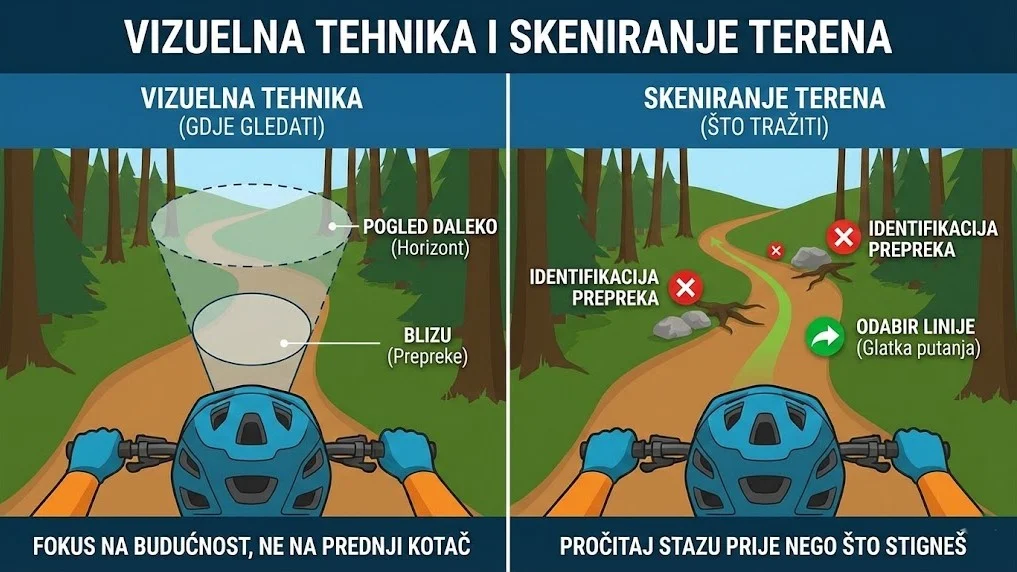
Goal: Good MTB vision technique and terrain scanning give you more time to react and lower your cognitive load by processing visual information the right way. They are the foundation of safe, fast riding.
Your brain needs roughly 0.5 - 1 second to process an image of an obstacle and send a command to your muscles. If you only look 1 metre ahead of your front wheel, you are already too late. Your speed dictates how far ahead you have to look.
Glossary of Key Terms
1. Gaze Biomechanics: The "Head & Chin" Principle
Head position dictates how your whole body works, so solid MTB vision technique starts here. Your head must be a stable platform, independent of the bike's vibrations.
| Element | Action | Goal |
|---|---|---|
| Chin Up | Keep your chin parallel to the ground; don't drop it toward your chest. | Opens your field of view and improves balance in the inner ear. |
| Horizon Scanning | Focus on the furthest point of the trail you can see. | Spot obstacles earlier and plan your line. |
| Peripheral Vision | Use your peripheral vision for objects right in front of the wheel. | Avoid locking your gaze onto the front wheel. |
2. Protocol: "Scan - Plan - Act"
This process has to run in a continuous loop, every second you ride.
3. Training Plan: Drills for Visual Precision
| Drill | Focus | Goal |
|---|---|---|
| The Pointer (Level 1) | Group ride; the leader points out obstacles with a hand. | Quick hazard identification and building focus in beginners. |
| Look Through (Level 2) | In a corner, turn your head fully toward the exit before you enter. | Radial vision through the turn and more speed in berms. |
| Blind Scanning | On a trail you know, try blinking once every 3 seconds. | Trains your brain to "fill in" the terrain map and boosts confidence. |
4. "Target Fixation" - How to Get Out of It (Safety Protocol)
It happens to everyone. You see a big rock, get scared, freeze your eyes on it... and hit it dead centre. Under stress the brain is "dumb" – it rides where the eyes go.
- Recognise it: The moment you realise you're "staring" at the hazard...
- Forced rotation: Physically, with sheer willpower, turn your head to the side (toward the clear path).
- Mantra: Shout in your head "Empty! Empty!" (look for open space).
5. How Fatigue Affects Your MTB Vision Technique
One of the first symptoms of physical fatigue is a drop in visual attention. As blood glucose falls, the brain switches to "survival mode", which leads to tunnel vision. Instead of scanning 15 metres ahead, your eyes drop to the front wheel.
Good MTB vision technique takes conscious effort when you're tired. If obstacles keep "surprising" you, it's a sign you've stopped scanning. At that point, slow down and deliberately lift your chin. Staying safe depends on your ability to see what's coming.
Nutrition for Cognitive Focus
Processing visual data uses a huge amount of energy in the central nervous system (CNS).
- Glucose: The brain relies primarily on glucose. A sugar drop causes "tunnel vision". Stay steady with 30-60g of carbs per hour.
- Caffeine: At doses of 3-6mg/kg it improves visual attention and reaction speed.
- Hydration: Even mild dehydration reduces visual acuity.
Scanning Checklist:
Pro Tips for Gear
Use light lenses (clear/yellow) in the woods. Dark lenses take information away from your brain.
If you can see your visor while riding, it's set too low. It forces you to drop your chin.