Protocol: Attack Position and Braking Technique
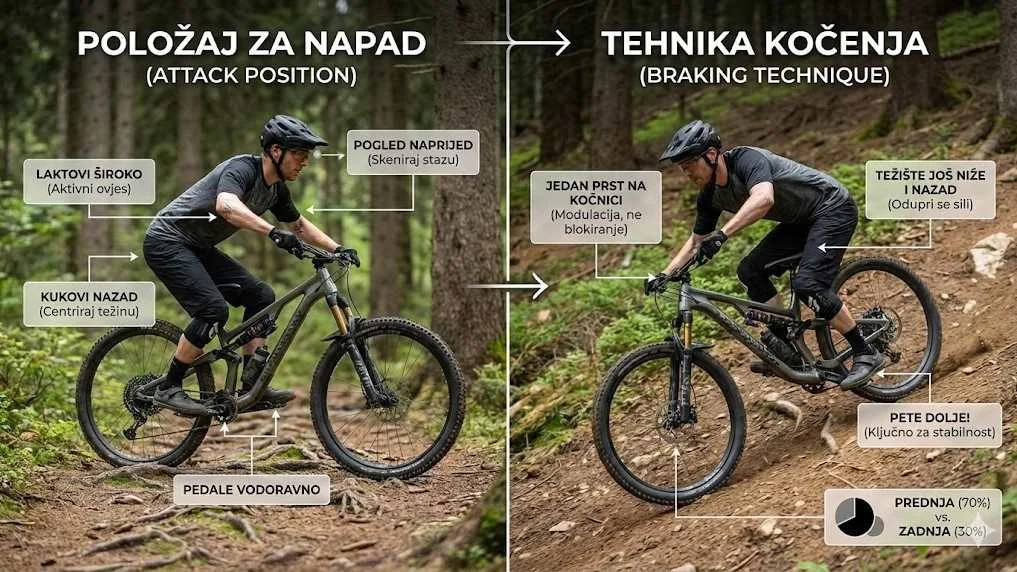
Goal: Reach maximum stability (Center of Gravity) from the attack position and slow down efficiently without locking your wheels.
The attack position and a solid MTB braking technique are the absolute foundation of safe riding. Without mastering this base, you can't progress on technical trails or carry more speed downhill without risk. This guide will teach you how to make your body and bike work as one.
1. Biomechanics: The Attack Position
This is the neutral base from which every movement on the bike starts. A correct attack position lets you react quickly to changes in the terrain.
| Element | What to do | Biomechanical goal |
|---|---|---|
| Feet | Pedals level, horizontal (3 and 9 o'clock). | Balance and avoiding pedal strikes on the ground. |
| Heels | Heels pushed down (Heels Down). | Anchoring the body; braking force goes through the legs, not the arms. |
| Knees/Elbows | Slightly bent and wide ("Wide elbows"). | Act as secondary suspension (shock absorbers). |
| Vision | Focus 5-10 meters ahead, not on the front wheel. | Early obstacle detection and line planning. |
| Center of gravity | Central, above the drivetrain (Bottom Bracket). | Keeping a low center of mass (CoG) for stability. |
The technique of dropping your heels below the pedal axis so your body "locks in" against inertial forces when braking or hitting bumps. This is a critical component the attack position relies on to prevent an OTB (going over the handlebars).
2. Braking Protocol (Braking Control)
Forget grabbing the brakes with a full fist. MTB braking is surgically precise and closely tied to the stability the attack position provides.
Key rules
- One-Finger Rule: Brake with your index finger only. The other fingers grip the handlebar firmly.
- Modulation: Meter your braking force like a throttle, not an "on/off" switch.
- Force distribution: In normal conditions, 70% front brake, 30% rear brake.
Biomechanical reaction
When you squeeze the brake, your body mass moves forward. To counter that, you need to:
- Action: Push your hips back (behind the saddle axis).
- Reaction: Pressure through your heels into the pedals increases, and your arms stay extended but not "locked".
3. Training Plan: Drills to Sharpen Your Skills
Do these exercises on flat ground or a gentle slope before every trail ride. Repetition builds the muscle memory for a solid attack position.
| Exercise | Repetitions | Focus | Goal |
|---|---|---|---|
| Neutral-to-Attack | 10 times | Moving from seated into the attack stance. | Muscle memory for your stance. |
| Emergency Stop | 5 times | Braking to a full stop using just your index finger. | A feel for brake power. |
| The Heavy Feet | 200 meters | Riding with no hand pressure on the bars (fingertips only). | Shifting your weight onto your legs. |
| Modulation Drill | 5 times | Slowing from 20 km/h to 5 km/h without locking the tires. | Skid control. |
4. Most Common Attack Position Mistakes
Many riders think their stance is correct, but they make subtle mistakes that compromise stability.
Standing with fully straightened, locked knees and elbows. In this state your body can't absorb impacts, so the bike bounces off the ground. A good attack position must be dynamic and fluid.
If you constantly hang behind the saddle, the front wheel loses traction and steering control. Your hips go back only under hard braking or on a steep descent; otherwise they stay centered above the drivetrain.
5. Advanced Application: The Dynamic Attack Position
Once you've mastered the basics, the attack position stops being a static pose. It becomes a "Range of Motion".
Your arms and legs are the bike's primary suspension. On big bumps, you pull the bike up toward you (flexing your limbs), and in dips you push it away from you (extending your limbs). This is called "pumping the terrain", and it's only possible if your basic stance starts from a correct, neutral attack position.
Nutrition for Technical Training
Technical training demands a high level of cognitive focus (your brain burns sugar).
- Pre-load: Take in 30-50g of carbohydrates (e.g. a banana or an energy bar) 30 min before practice.
- Focus: Dehydration of just 2% drastically reduces motor skills and balance. Drink 500-700ml of fluid per hour.