Protocol: The Pumping Technique – Free Speed
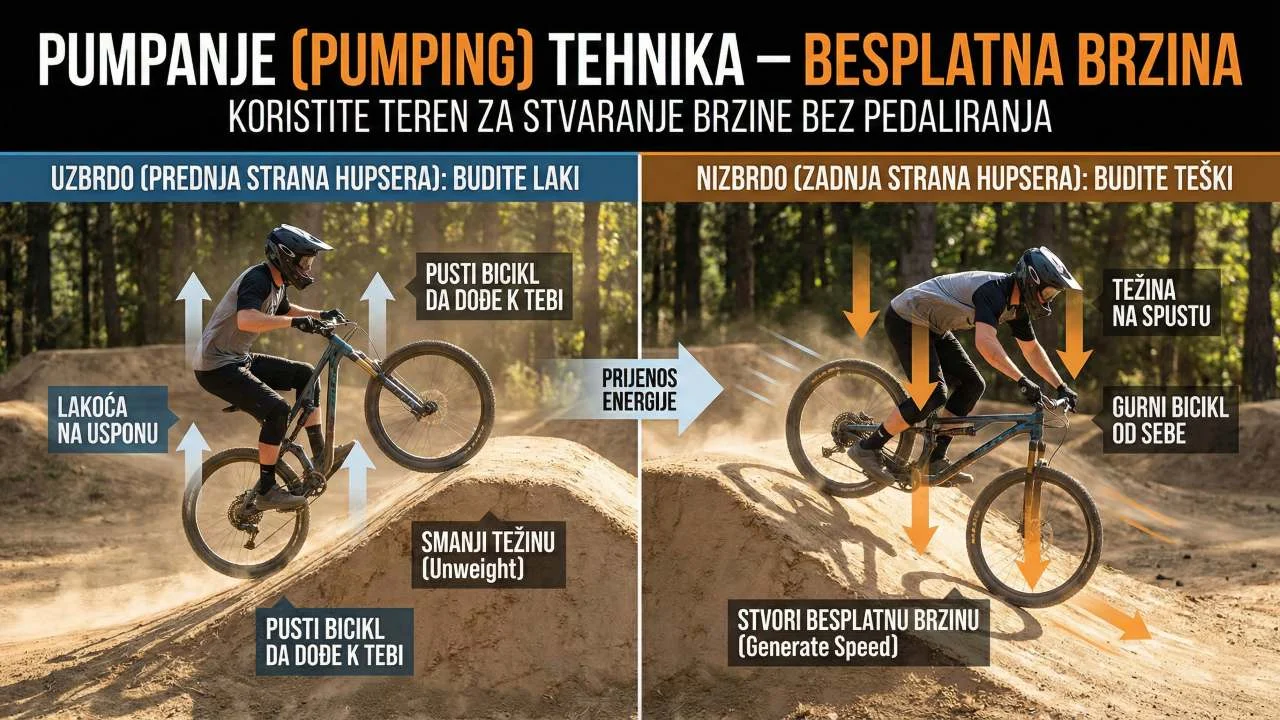
Goal: Master the pumping technique to generate "free" speed (momentum) by compressing and unweighting the bike in sync with the terrain.
It works on the law of conservation of energy. When you hit a downslope (even a 1-metre one), gravity speeds you up. Add a strong push through your legs and arms (like on a swing) and your mountain bike momentum multiplies without using the chain.
Glossary of Key Terms
1. Physics and Biomechanics: The Swing Effect
Imagine you're on a swing. On the way up, you tuck in. On the way down, you snap your legs straight. That creates speed without anyone pushing you.
- Arms: Start the movement and "lead" the front wheel over the crest.
- Legs: Generate most of the power (the engine). Explosive knee extension on the way down creates speed.
2. Protocol: Pumping Phases on a Series of Rollers
Learning how to pump a mountain bike comes down to one thing: the "Pull - Push" cycle has to happen in a steady rhythm.
| Terrain phase | Body action | Physics | Common mistake |
|---|---|---|---|
| Uphill (Rising Face) | Pull / Tuck in | Unweighting. | Lifting your body upwards (jumping). |
| Top (Crest) | Transition | Zero point. The switch-over. | Pedaling at the top (pedal strike). |
| Downhill (Falling Face) | Push / Extend | Weighting. | Late timing (pushing at the bottom). |
| Bottom (Trough) | Reset | Preparing for the next roller. | Staying stiff (being static). |
3. Training Plan: Pump Mastery
The best place to learn the pumping technique is an asphalt Pump Track. The rule: no pedaling allowed.
Goal: Ride the entire loop without a single pedal turn. Start slowly and focus on timing: Up-Light, Down-Heavy.
With your eyes closed (in a safe spot), pump small bumps. This builds your feel for the changing pressure under your wheels (proprioception).
4. Trail Application
The pumping technique isn't just for the pump track. It turns natural obstacles into a source of speed.
Instead of smashing into a root, "absorb" it (pull the bike up) and push the bike into the ground as soon as you're over it.
Every rock has an "exit ramp". Push the rear wheel down it to get a free boost.
Every berm is really a bump turned on its side. Pumping the corner exit launches you forward.
5. Most Common Mistakes (Troubleshooting)
- Stiff legs: The rider only uses their arms. The legs stay fixed. This leads to quick arm fatigue and low speed. The power is in your legs!
- Late Pumping: You push the bike when it's already at the bottom of the dip. That makes the front wheel slam into the next rise. You have to push IMMEDIATELY after the crest.
- Jumping: Beginners think they need to jump off the bump. For speed, your wheels should stay on the ground (because the ground is where you get traction to push against).
Pro Tip: Your Head Is a Gyroscope
While you pump, the bike moves up and down like a piston in an engine (amplitude of up to 50cm). Your head and shoulders should travel in a straight line, as if on rails. The calmer your head, the more efficient your pumping technique will be.