Bike frame size is the first thing to check before you buy a bike, before colour, components and price. The wrong frame can't be fixed with any upgrade: on a bike that's too big you feel stretched out and unsafe on descents, and on one that's too small your knees and back hurt after the first hour. In this guide you'll find a bike size chart by height for MTB, road, gravel, city and kids' bikes. We also explain how to measure your inseam yourself and what to do when you fall between two sizes.
In short:
- Bike frame size is chosen mainly by inseam length, and your height is only a rough guide.
- For MTB: a height of about 160–170 cm suits size S, 170–180 cm size M, 180–190 cm size L, and over 190 cm size XL.
- The MTB formula in inches is inseam in cm × 0.226; for a road frame in cm it is inseam × 0.665.
- On modern MTBs, the manufacturer's chart and the reach measurement matter more than the number in inches, because frames from different brands vary in length.
- Between two sizes, choose the smaller one for a playful ride and jumps, and the larger one for stability and longer rides.
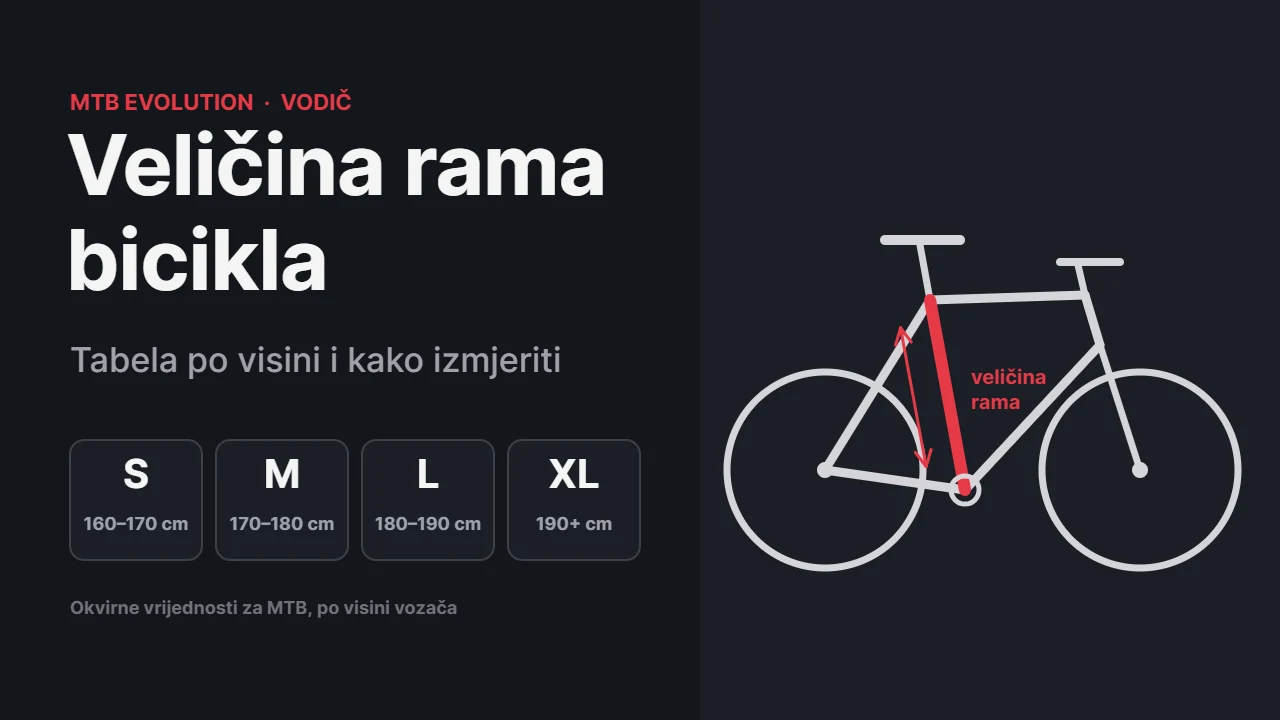
Bike Frame Size: What Exactly Is Measured
The classic frame size is the length of the seat tube, measured from the centre of the bottom bracket (the pedal axle) to the top of the tube or to the middle of the top tube, depending on the manufacturer. On MTBs it is traditionally given in inches (e.g. 17"), on road and gravel bikes in centimetres (e.g. 54 cm), and today most brands use simple labels: XS, S, M, L and XL.
The problem is that this label no longer tells the whole story. Modern MTB frames have short seat tubes to make room for a long dropper post, so two "size M" frames from different brands can be completely different lengths. That's why two more measurements matter for an accurate choice:
- Reach: the horizontal distance from the bottom bracket to the top of the head tube. It determines how stretched out you are when standing on the pedals. For MTB it is the most important number.
- Stack: the vertical height of the top of the head tube above the bottom bracket. A higher stack means a more upright, comfortable position.
To learn more about how angles and frame lengths affect the way a bike handles, read our article on e-MTB geometry, and see the names of all frame parts in our interactive bike anatomy. A general technical overview of frame construction is also available on Wikipedia (Bicycle frame).
Bike Frame Size Chart by Height
This is the approximate frame size by height: the values in the tables fit riders of average proportions. If your legs are longer or shorter than average, go by your inseam length (see the next section), and do the final check in the manufacturer's chart for the specific model.
MTB (hardtail and full suspension)
Use this mountain bike size chart as a starting point, whether you ride a hardtail or one of the full suspension bikes on the market today.
| Rider height | Size | Frame in inches | Wheels |
|---|---|---|---|
| 150–160 cm | XS | 13–14" | 27.5" |
| 160–170 cm | S | 15–16" | 27.5" or 29" |
| 170–180 cm | M | 17–18" | 29" or mullet |
| 180–190 cm | L | 19–20" | 29" |
| over 190 cm | XL | 21–22" | 29" |
If a mixed-wheel setup interests you, we compare the trade-offs in our guide to the mullet bike.
Road and gravel bikes
For road bike frame size, the numbers are in centimetres along the seat tube:
| Rider height | Size | Frame in cm |
|---|---|---|
| 150–160 cm | XS | 47–49 cm |
| 160–170 cm | S | 50–52 cm |
| 170–180 cm | M | 53–55 cm |
| 180–190 cm | L | 56–58 cm |
| over 190 cm | XL | 59–62 cm |

City and trekking bikes
| Rider height | Frame in cm |
|---|---|
| 150–160 cm | 43–46 cm |
| 160–170 cm | 47–50 cm |
| 170–180 cm | 51–54 cm |
| 180–190 cm | 55–58 cm |
| over 190 cm | 59 cm and up |
Kids' bikes (wheel size)
For kids' bikes you choose the wheel size instead of the frame size:
| Child's height | Approximate age | Wheel |
|---|---|---|
| 85–100 cm | 2–4 years | 12" |
| 95–110 cm | 3–5 years | 14" |
| 105–120 cm | 4–6 years | 16" |
| 115–135 cm | 6–9 years | 20" |
| 130–150 cm | 8–12 years | 24" |
| from about 145 cm | from 11 years | 26" or 27.5" (XS frame) |

How to Measure Your Inseam
Inseam length is more accurate than height, because two people of the same height can have different leg lengths. Measuring takes two minutes:
- Take off your shoes and stand against a wall. Keep your feet about 15–20 cm apart, as when you stand over a bike.
- Place a book between your legs. Point the spine upwards and pull it firmly up to your crotch, like a bike saddle.
- Mark the height of the spine on the wall. The book must be level; it's easiest if someone else makes the pencil mark.
- Measure the distance from the floor to the mark. That is your inseam length in centimetres.
- Repeat the measurement twice. Take the average, because a difference of just 2 cm changes the calculated frame size.
Formulas for Calculating Frame Size
Once you know your inseam length, you can roughly calculate your bike frame size:
| Bike type | Formula | Example (82 cm inseam) |
|---|---|---|
| MTB | inseam (cm) × 0.226 = frame in inches | ≈ 18.5" (size M/L) |
| Road and gravel | inseam (cm) × 0.665 = frame in cm | ≈ 54.5 cm (size M) |
| City and trekking | inseam (cm) × 0.685 = frame in cm | ≈ 56 cm |
The same measurement is used to set your saddle height after you buy. We describe the procedure in detail in our guide to bike seat adjustment.
Between Two Sizes: Which One to Choose
If the chart puts your bike frame size right on the borderline, the decision depends on how you ride:
- Smaller frame: more playful and easier to turn, better for jumps, bike parks and technical trails. It suits riders with shorter arms and torsos.
- Larger frame: more stable at higher speeds and on long descents, and more comfortable on long rides and marathons. It suits riders with longer arms.
On an MTB you can fine-tune your position later with a shorter or longer stem, but you can't make up for a whole size. If you're still choosing the type of bike, a comparison of full suspension and hardtail bikes will help.
Three Quick Checks Before You Buy
- Standover clearance: standing over the bike with both feet on the ground, there should be 2–5 cm between the top tube and your crotch on a road bike, and 5–10 cm on an MTB.
- Arm reach: in the seated position your elbows are slightly bent, not fully extended or cramped against your body.
- Saddle height: if the frame is well chosen, at your adjusted saddle height the seatpost must not be pulled out past the minimum insertion mark. If it is, the frame is too small.
Electric Bikes: Same Rules, One Exception
For e-bikes, the bike frame size is chosen from the same charts as for regular bikes of the same type. The difference is that an e-bike is heavier, so an oversized frame is an even bigger problem on an e-MTB when manoeuvring and pushing uphill. If you're between two sizes, the smaller one more often makes sense on an e-MTB. To read more about choosing your first electric bike, see our guide e-bike for beginners.
If you're still not sure which type of bike you need, use our bike selection calculator or the general guide how to choose the right bike.
Bought a bike and not sure it fits you? In the workshop we check the frame size and adjust the saddle height and position, the handlebars and the levers to your body.
Book an appointmentQuick Recap: How to Choose Your Frame Size
Choosing your bike frame size takes three steps: measure your inseam, compare it with the manufacturer's chart, and test the bike before you buy. If you're between two sizes, the right pick depends on your riding style: a smaller frame is more agile, and a larger one is more stable on descents.
- For an MTB, choose by inseam and reach, not just by height.
- Fit can be fine-tuned with saddle height and stem length.
- Before buying a used bike, check the size label on the seat tube.
If you're not sure, come to our bike service for measuring and position adjustment, or contact us with your questions. For kids, read the guide how to choose a kids' bike.
Frequently Asked Questions
What bike frame size do I need for a height of 175 cm?
For a height of 175 cm, an MTB frame in size M (17–18 inches) roughly fits, and a road or gravel frame of 53 to 55 cm. Determine the exact size by your inseam length and the manufacturer's chart for the specific model.
How do you measure a bicycle frame?
Frame size is traditionally measured along the seat tube, from the centre of the bottom bracket to the top of the tube. On modern MTBs, the reach and stack measurements from the manufacturer's geometry chart matter more.
Is it better to choose a larger or smaller frame if I'm between two sizes?
A smaller frame is more playful and better for technical trails and jumps, while a larger one is more stable at speed and more comfortable on long rides. On an e-MTB a smaller size is more often recommended because of the bike's weight.