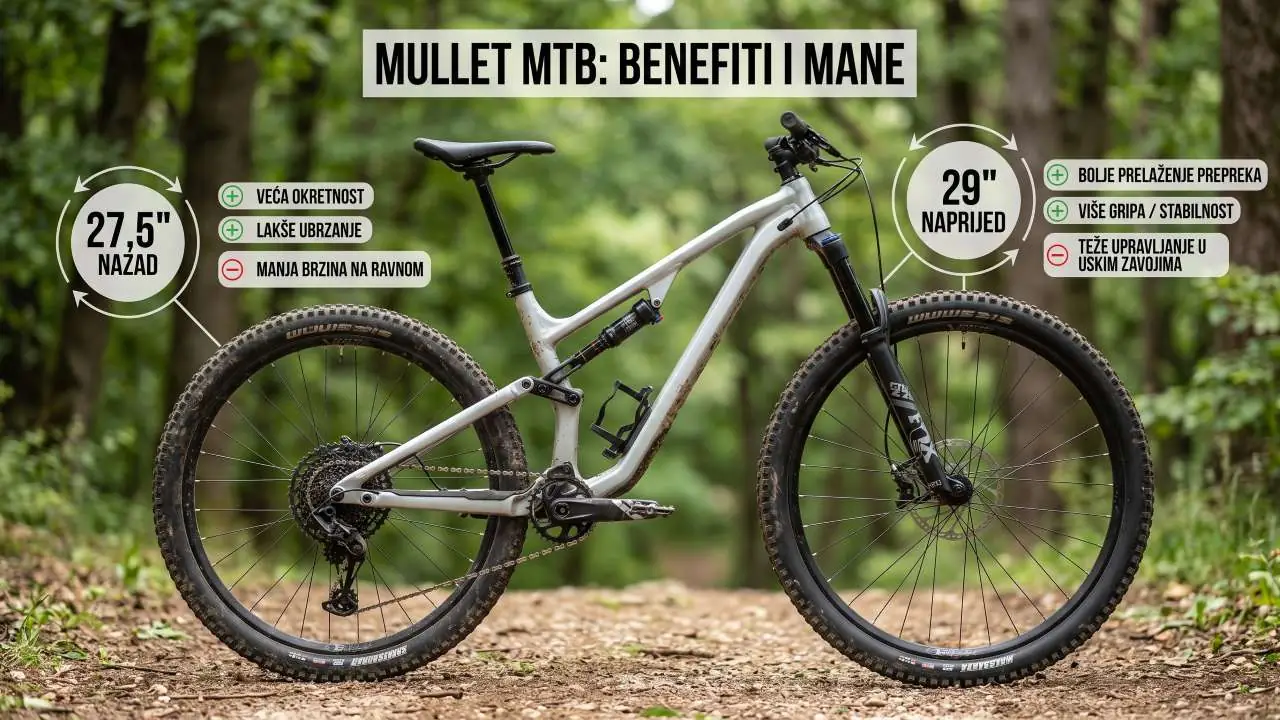
A mullet bike, or mullet MTB, is a mountain bike with a 29-inch front wheel and a 27.5-inch rear wheel. The idea is simple: the big front wheel rolls over rocks, roots and steps more easily, while the smaller rear wheel makes the bike more agile and playful and leaves you more room when you drop behind the saddle. In this guide I explain the real pros and cons of the mullet setup, how it changes bike geometry and who it makes sense for, based on what we see in the workshop and on the trails of Bike Park Evolution.
In short:
- A mullet MTB combines a 29-inch front wheel with a 27.5-inch rear wheel; the difference in diameter, tyre included, is about 50 mm.
- Main benefits of the mullet setup: better obstacle roll-over at the front, agility in corners and more room behind the saddle on steep descents.
- Main drawbacks: slightly slower rolling on flats and climbs, less rear traction and a lower bottom bracket (about 10 to 15 mm when converting a 29er frame).
- Mullet has been the standard in the Downhill World Cup since 2019, while for enduro and trail riding the decision depends on terrain and riding style.
- Converting an existing bike means checking with the frame manufacturer, adjusting the suspension and checking pedal clearance.
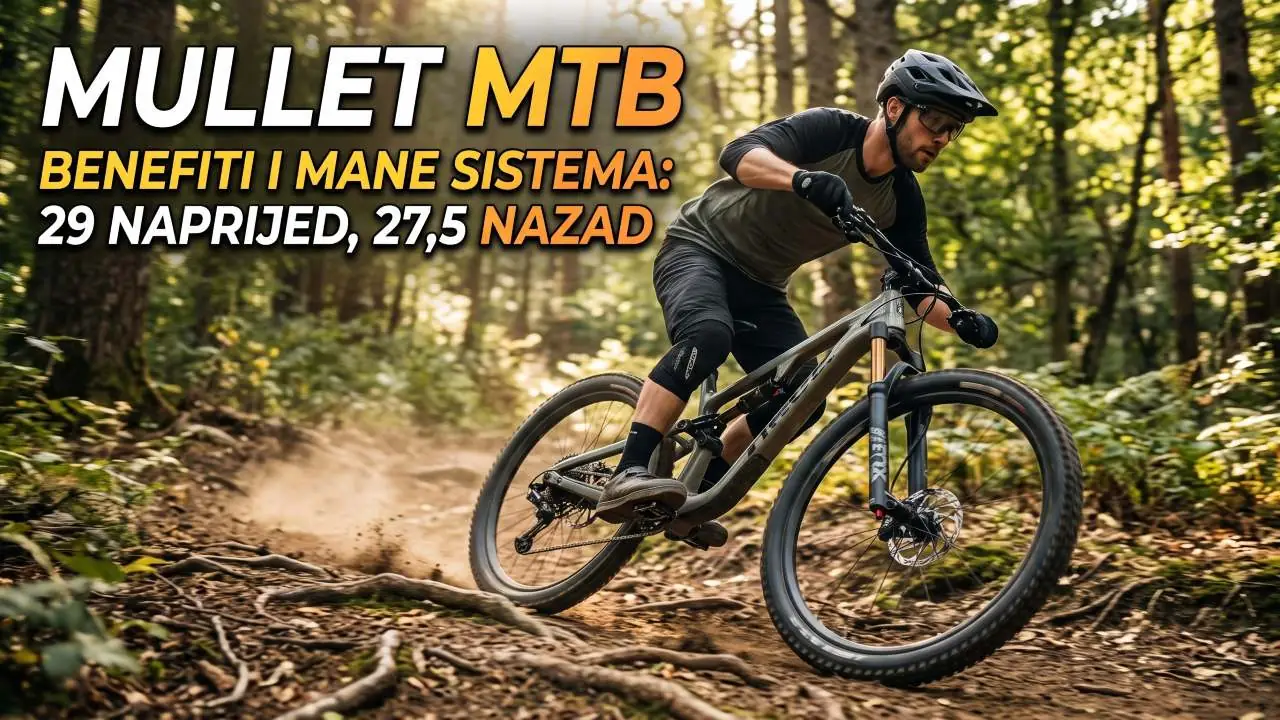
What is a mullet bike and where does the name come from
The name comes from the famous 1980s haircut: short at the front, long at the back, or in MTB slang, "business up front, party at the back". On a bike the sizes are the other way around, but the character is the same: a serious, stable front end and a playful rear end. When we say mullet bike, we almost always mean 29 in front and 27.5 at the back, although there were earlier variants (26 front, 24 rear). In English-language literature the same concept is also called a mixed wheel MTB.
The real push behind the mullet MTB came from the Downhill World Cup. When the UCI allowed different wheel sizes from the 2019 season, riders quickly realised that a full 29er is the fastest in a straight line but leaves little margin for error, and that a big rear wheel gets in the way on steep sections. Mullet gave almost the same speed with more control, so today it is the dominant setup in downhill, and more and more enduro and trail bikes come in a mullet version or with the option to choose.
Benefits of the mullet MTB system
When a rider sits on one of these bikes for the first time, they usually notice two things: the front end feels calm and secure over rocks, and the rear wheel "listens" much faster than on a full 29er. Here is where that comes from.
1. The 29-inch front wheel rolls over obstacles better
A larger wheel meets an obstacle at a shallower angle, so it climbs over a rock, root or the edge of a step without a sudden jolt through your hands. Since the front wheel hits the obstacle first and has the biggest effect on safety, that is exactly where a 29 is most useful. The mullet setup keeps that "monster truck" feeling at the front, which is a big advantage on technical descents.
2. Agility and quicker changes of direction
The smaller rear wheel is lighter, has less rotational inertia and usually comes with shorter chainstays. The result is a bike that enters a corner faster, flicks more easily from berm to berm and lifts more easily into a manual or bunny hop. On our trails with tight switchbacks and strings of berms, such as Roller Coaster in Bike Park Evolution, a mullet feels more playful than a classic 29er.
3. More room behind the saddle
This is a benefit shorter riders feel straight away. On a steep descent your body goes back and low, and a big 29-inch rear wheel can hit your backside or catch your shorts. A 27.5-inch rear wheel leaves a few centimetres more room, so you can move around the bike more freely. That is why I especially recommend a smaller rear wheel for riders under about 175 cm and anyone who rides steep, technical descents.
4. Slacker head angle and more stability
When an existing 29er is turned into a mullet, the rear end drops and the frame tilts back slightly. The head angle becomes about 0.5 to 1 degree slacker, which gives calmer steering at high speed and less handlebar "twitch" over rocks. For downhill and enduro that is generally a good thing.
5. Less weight and quicker acceleration of the rear wheel
With the same rim and tyre construction, a 27.5-inch rear wheel is lighter, usually by about 100 to 200 grams. Weight at the rim is felt most when accelerating out of slow corners and when jumping, so the bike feels livelier. This is especially interesting on electric MTBs, where frames are longer because of the battery and motor, so every bit of added agility helps.

Drawbacks of the mullet MTB system
Mullet is not a magic fix. Every benefit comes at a price, and it is important to know it before you buy or convert.
1. Slower rolling on flats and climbs
The rear wheel carries most of the rider's weight, and a smaller wheel has higher rolling resistance over bumps. On long climbs, fire roads and marathons a full 29er is more efficient. That is why you almost never see mullet setups in cross-country, and even in enduro some riders stay on a full 29er because of long transfers and pedalling sections.
2. Less rear traction
A smaller wheel has a slightly shorter contact patch with the ground. In corners the rear wheel is therefore the first to lose grip, and the bike steps out at the back more easily. Experienced riders like this because the bike is easy to control with a slide, but for beginners it can be unsettling, especially on wet roots and loose surfaces. On steep, slippery climbs less traction also means more wheelspin.
3. Lower bottom bracket and pedal strikes
When you convert a bike designed for a 29-inch rear wheel, the bottom bracket (BB) drops by about 10 to 15 mm. That increases stability, but also the number of times you hit a rock with a pedal or crank. If you ride rocky trails with a lot of pedalling, this is a drawback you will feel quickly.
4. Slacker seat angle and shorter reach
The same frame tilt that slackens the head angle also slackens the seat angle. You sit slightly further behind the bottom bracket, which on steep climbs means the front end lifts more easily and pedalling is less efficient. The reach shortens slightly too, so your position on the bike changes a little. I write more about how these angles affect riding in the guide to MTB geometry.
5. The suspension needs to be set up again
When the centre of gravity moves back, the fork gets less load and the rear shock gets more. After switching to a mullet setup you usually need to lower the fork pressure a little, raise the shock pressure and check the rebound. Without that, the bike can feel "heavy" at the back and nervous at the front. You will find the detailed procedure in the article on MTB suspension tuning.

Mullet MTB vs 29 vs 27.5: a comparison in numbers
The table below is approximate and refers to enduro and trail bikes with similar suspension travel. Actual values depend on the frame, tyres and setup.
| Characteristic | Full 29 | Mullet MTB (29/27.5) | Full 27.5 |
|---|---|---|---|
| Obstacle roll-over at the front | Excellent | Excellent | Good |
| Agility in corners | Good | Very good | Excellent |
| Rolling on flats and climbs | Best | Good | Weaker |
| Rear traction | Most | Medium | Medium |
| Room behind the saddle | Least | More | Most |
| Best use | XC, marathon, trail | Downhill, enduro, bike park | Freeride, dirt, shorter riders |
Mullet is not a question of speed on the stopwatch, but of confidence. If you feel restricted by a big rear wheel on a steep descent, a mullet will change your riding more than any new component.
— Marko Ristivojević
Who is a mullet bike the right choice for
Put simply: mullet is for riders who care more about the descent than the climb. More specifically:
- Downhill and bike park riders - mullet is the standard today, both in the World Cup and on local trails with jumps and berms.
- Enduro riders on technical trails - if the special stages are steep and narrow, a mullet setup gives more control; on fast, open trails a full 29 remains excellent.
- Shorter riders - more room behind the saddle is the most important reason for a smaller rear wheel for riders under about 175 cm, especially on smaller frame sizes.
- Riders who like a playful ride - manuals, jumps, throwing the rear end through corners.
- Electric MTB owners - long eMTB frames gain agility, and the motor makes up for the slower rolling on climbs.
On the other hand, if you ride marathons, long tours and XC, stay with a full 29 system. If you are not sure which bike category suits you, take a look at the comparison of trail, enduro and downhill bikes and the guide to full suspension bikes.
How to convert a bike to a mullet MTB
Converting to a mullet is not just swapping a wheel. This is the order we follow in the workshop:
- Check the frame manufacturer's approval. Many newer frames have a flip chip or special shock mounts for a mullet setup; some manufacturers do not approve the conversion and it can affect your warranty.
- Get a suitable rear wheel. The hub standard (e.g. Boost 148 mm), axle type, cassette system and disc must match the frame and drivetrain.
- Adjust the geometry. If the frame has a flip chip, switch it to the high position to restore the bottom bracket height. If you are converting a 27.5 frame to a mullet, check that the fork accepts a 29-inch wheel.
- Set up the suspension. Lower the fork pressure, raise the shock pressure, measure the sag again and check the rebound.
- Check the tyres and pressure. The 27.5-inch rear tyre can be slightly wider or have a more aggressive tread; set the pressure according to our guide to bike tyre pressure.
- Test on a trail you know. Pay attention to pedal strikes, behaviour in corners and your position on the climb.
If you would rather not do the conversion yourself, we can do the mullet setup, wheel truing and suspension tuning as part of a bike service at the MTB Evolution workshop in East Sarajevo.
Thinking about a mullet setup? Bring in your bike and we will check frame compatibility, geometry and suspension before you spend any money.
Book an appointmentIs a mullet bike faster than a 29er?
Short answer: sometimes, but the difference is small. Tests on the same trails with the same riders show differences of only about one percent, sometimes in favour of the mullet setup, sometimes in favour of the full 29. What matters far more is how secure the rider feels. Manufacturers such as Canyon, in their mullet bike guide, conclude that mullet is a clear win for downhill and a matter of personal choice for enduro and trail, which matches our experience on the trails around East Sarajevo.
Conclusion: mullet bike pros and cons
A mullet takes the best of both worlds: a 29-inch front wheel for confidence and roll-over, and a 27.5-inch rear wheel for agility, room and fun. The price is slightly slower rolling, less rear traction and a lower bottom bracket. If the descent is the most important part of your ride, if you are a shorter rider or you like a playful bike, a mullet setup is an excellent choice. If you pedal long tours and marathons, a full 29 is still the better tool. As a mechanic and trail builder, I give one piece of advice: before you decide, try both systems on the trail you ride most often.
Frequently asked questions about mullet bikes
Is a mullet MTB faster than a bike with two 29-inch wheels?
The difference is small and depends on the trail and the rider. Tests show differences of about one percent. On steep, technical descents a mullet MTB is often faster because it gives more control, while on flats and climbs a full 29 bike is more efficient.
Can I convert my 29er into a mullet?
Mostly yes, with a 27.5-inch rear wheel that has the same hub standard. First check whether the frame manufacturer approves the conversion, because the bottom bracket drops by about 10 to 15 mm and the head and seat angles become slacker. After the conversion, set up the suspension.
Who is a mullet MTB best for?
A mullet MTB is best for downhill, bike park and technical enduro riders, for shorter riders who find a big rear wheel in the way on steep descents, and for electric MTB owners. For marathons, XC and long tours a full 29 system is better.