Bike tire pressure is the cheapest upgrade you can make to your bike. Whether you ride MTB, road, gravel, or an e-bike, correctly adjusting your tire pressure is the cheapest upgrade you can make to your bike. Too much pressure will "bounce" you off the trail, while too little risks rim damage.
Bike tire pressure in short:
- Pressure depends on rider weight, tire width and terrain.
- The rear tire needs about 0.2–0.3 bar more than the front, because it carries 60–65% of your weight.
- Tubeless lets you drop about 0.2 bar more without pinch flats.
- E-bikes need 0.3–0.5 bar more than a standard bike of the same type.
- In mud, lower pressure by about 0.2 bar compared to dry conditions.
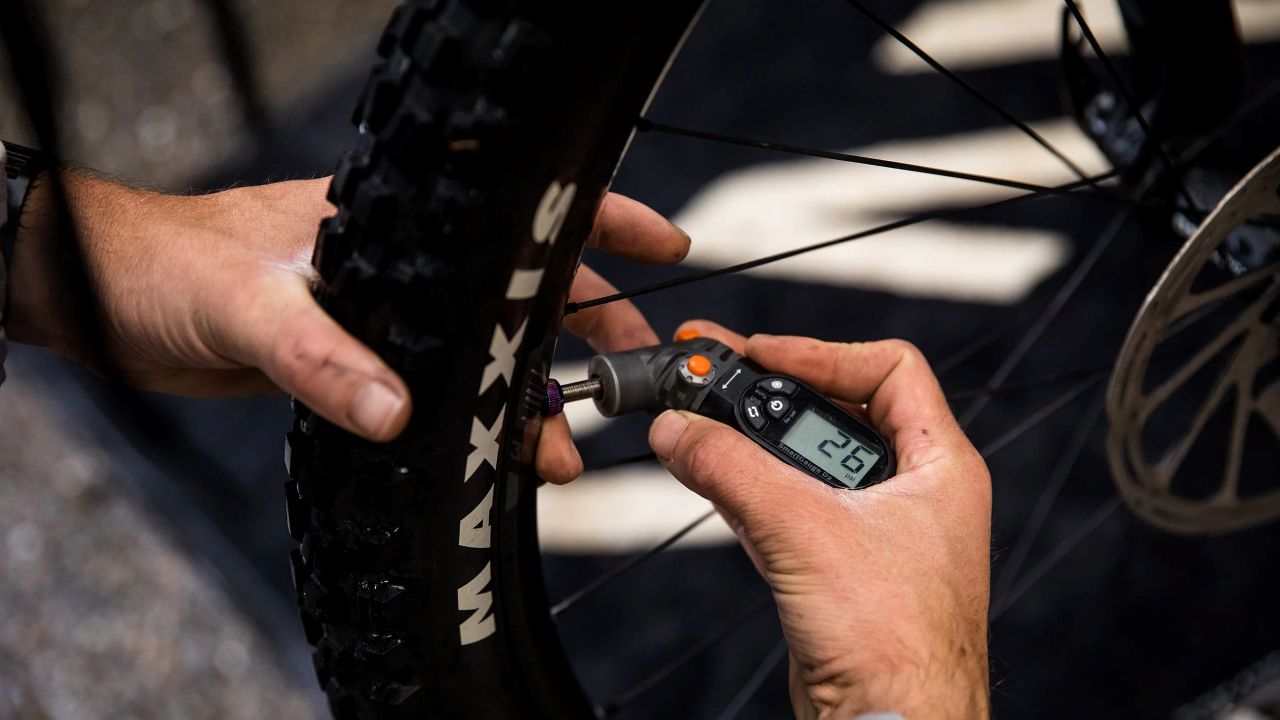
Bike tire pressure chart (bar and PSI)
This chart serves as a starting point. Keep in mind that the rear tire should always have 0.2-0.3 bar more because it carries a larger portion of your weight.
| Rider Weight | Front (Bar/PSI) | Rear (Bar/PSI) |
|---|---|---|
| 🚵 MTB (29" wheels) | ||
| 60 - 70 kg | 1.6 (23 PSI) | 1.8 (26 PSI) |
| 70 - 85 kg | 1.8 (26 PSI) | 2.0 (29 PSI) |
| 85 - 100 kg | 2.1 (30 PSI) | 2.3 (33 PSI) |
| 🚴♀️ Gravel (40mm tires) | ||
| 60 - 70 kg | 2.4 (35 PSI) | 2.6 (38 PSI) |
| 70 - 85 kg | 2.8 (40 PSI) | 3.0 (44 PSI) |
| 85 - 100 kg | 3.2 (46 PSI) | 3.5 (50 PSI) |
| 🚴♂️ Road (25mm / 28mm) | ||
| 60 - 70 kg | 6.0 (87 PSI) | 6.2 (90 PSI) |
| 70 - 85 kg | 6.8 (98 PSI) | 7.0 (102 PSI) |
| 85 - 100 kg | 7.5 (108 PSI) | 7.8 (113 PSI) |
Want a precise bike tire pressure, down to the decimal? The chart above is a general recommendation. Our advanced algorithm takes into account your exact weight, tire width, terrain type, and whether you ride Tubeless.
Open tire pressure calculatorBike tire pressure by bike type
MTB (mountain biking)
With MTB, lower pressure means better grip (traction). The tire molds better around roots and rocks.
- Tubeless advantage: If you ride without an inner tube (tubeless), you can safely drop the pressure by another 0.2 bar without the risk of a "snake bite" pinch flat.
- Tire width: The wider the tire (e.g., 2.4" or 2.6"), the lower the pressure should be.
- Tire inserts (CushCore): By using protective inserts (foam) in the tire, you can ride at significantly lower pressures (even down to 1.2 bar) gaining maximum traction on enduro trails, without fear of breaking the rim.

Road bikes
Here the goal is to reduce rolling resistance. However, it is a myth that the tire must be "rock hard". Too high of a pressure on bad asphalt actually slows the bike down because it "bounces" instead of rolling.
E-bikes
Due to the heavier weight of the bike (battery + motor), an E-bike requires 0.3 to 0.5 bar more compared to a standard bike of the same category to protect the rims from impacts. It is also recommended to use tires with a thicker "Casing" (protective sidewall).
Don't forget the suspension
Tire pressure is your first line of suspension. Even a perfectly tuned shock won't work well if the tires are overinflated. Once your bike tire pressure is set, tune your shock: our FOX shock rebound and compression guide (in Bosnian) explains it step by step.
Conclusion: fine-tune your bike tire pressure on the trail
Experiment! Bring a small pump on your ride. Start with the values from our calculator, and then fine-tune based on how it feels on the trail.
Tire manufacturers publish their own pressure ranges, for example Schwalbe. Never go below or above the range printed on the sidewall.
Bike tire pressure: frequently asked questions
How often should you check your tire pressure?
Ideally before every ride, and at least once a week. Air naturally leaks through the tire, especially with tubeless systems.
Why is the pressure higher in the rear tire?
The rear wheel carries about 60–65% of the rider weight. Higher pressure stops the tire from squirming in corners and protects the rim.
What tire pressure should I use in mud?
Lower it by about 0.2 bar (3 PSI) compared to dry conditions. That increases the contact patch and improves traction.