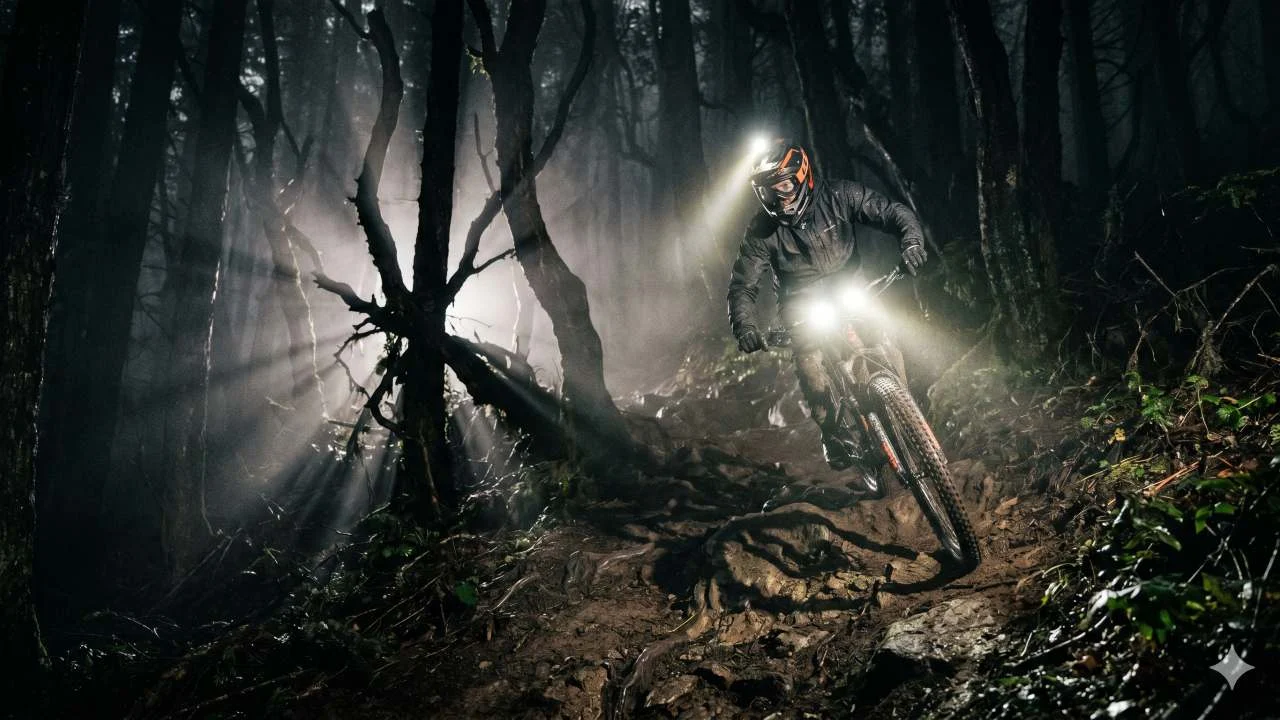
Night riding in the bike park is a completely new sport, not just "riding in the dark". You know that feeling when you can ride your favorite park with your eyes closed: every root, every berm, the exact speed for the jump in the middle section. Now imagine all of that disappearing. All that's left is a tunnel of light, the sound of tires scratching the dirt and your own pulse echoing in your helmet.
The visual references you rely on during the day vanish, the speed feels doubled and familiar trails become uncharted territory. It's a pure, double dose of adrenaline at Bike Park Evolution in East Sarajevo.
Night downhill at a glance:
- Dual lighting is mandatory: a wide-beam handlebar light and a narrow spot-beam helmet light.
- Aim for a combined output of around 2000 lumens (about 1200 on the bars and 800 on the helmet).
- Night riding solves the summer heat problem, with better grip and crisper air.
- Clear goggles are mandatory to protect against bugs and branches in the dark.
- Ride only trails you know by heart, and never ride alone.
Escaping the heat: why night riding in the bike park is ideal in summer
Why risk your neck in the dark in the first place? If you've ever ridden in July and August, when trail temperatures exceed 35°C and even your brakes struggle to cool down, you know exactly what we're talking about.
Night riding in the bike park during summer is pure salvation. You avoid harsh UV and dehydration, and the trail itself changes: evening dew settles the dust, tires suddenly hook up much better and the fresh mountain air lets you ride longer laps without overheating.
Mandatory gear for night riding: no compromises
For night riding in the bike park to be epic rather than disastrous, improvisation is out of the question. Besides standard park gear (full-face helmet, knee and back protection), night conditions require:
- Clear goggles: forget tinted lenses. Clear lenses protect you from branches you won't see until the last second and from swarms of bugs attracted by your beam.
- Fully charged batteries (and a power bank): charge right before the ride. Lower night temperatures can drain batteries much faster.
- Tool kit: fixing a mechanical in the dark is three times harder. A quality multitool and a tubeless kit are a must in your backpack.
The golden rule: how many lights and where to mount them
If you think one powerful handlebar light is enough for night riding in the bike park, trust us, it's not. For aggressive riding and technical sections you need two lights. A handlebar light only illuminates where the front wheel points, while your vision, especially in berms and rollers, is focused far ahead and to the sides. Without the right setup you'd enter corners completely blind.
| Light | Beam | Job | Target output |
|---|---|---|---|
| Handlebar | Wide | Lights the ground ahead; shadows help you judge depth of rocks and roots | ~1200 lumens |
| Helmet | Narrow / spot | Lights where you look, e.g. the corner exit | ~800 lumens |
| Combined | – | Sweet spot for fast park laps without heavy battery packs | ~2000 lumens |
The helmet light should be lighter so it doesn't strain your neck. When you dive into a sharp corner your body stays upright while your head looks toward the exit, and the helmet light follows your eyes. For more background on beam types and output, see the bicycle lighting overview on Wikipedia.
Never look directly into the dust kicked up by the rider in front of you. Their dust combined with your bright light creates a white-wall effect you'll crash into blindly. Keep a safe distance, don't ride right on their rear tire, and focus through the fog.
— Marko Ristivojević, Master Bike Mechanic
How to overcome the fear of the dark woods
The woods come alive at night, and that is what makes night riding in the bike park feel so intense. Fear of the dark is evolutionarily justified, but in the bike park you beat it with preparation.
Ride trails you know by heart. Night riding is not the time to explore new lines; ride what your muscles already remember, such as the Roller Coaster trail or Fox Skull. Next, never ride alone. Hearing your buddy's freewheel ahead or behind you instantly strips away the horror-movie vibe.
Focus on the tunnel of light. Your world is now just those 15–20 meters; everything outside doesn't exist. Tune out your imagination, dial up your focus, and dopamine will quickly replace the fear.
Watch it: Roller Coaster night ride
To show what night riding in the bike park really looks like, check out our night run down the Roller Coaster trail. Feel the speed and the tunnel of light.
Ready for the night shift? Night riding in the bike park will make you a far better rider. It forces you to rely on intuition and gives a unique sense of speed. Prep your bike, charge your batteries and see you on the trails.
Brakes properly bled and suspension absorbing every hit? Get your bike checked before the night shift.
Schedule a full serviceFrequently asked questions
Is one powerful light enough for night riding in the bike park?
Not recommended. With a light only on the handlebars you illuminate the outside of the woods instead of the corner exit. A handlebar light for the ground plus a helmet light for your line of sight is the only safe choice.
What is the minimum lumen count for night riding in a bike park?
For technical trails we recommend a combined output of around 2000 lumens, for example 1200 on the bars and 800 on the helmet. Anything below that requires riding significantly slower.
What if I get a flat tire in the dark?
Always carry a small headlamp in your backpack as a backup. Fixing a tubeless flat in total darkness is nearly impossible without free hands and a direct light source.