Dropper post service becomes unavoidable the moment your telescopic seatpost starts sinking under your weight, returns slowly or begins to wobble. A dropper is standard on every trail and enduro bike today, but it is also the component riders neglect most, right up until it fails halfway down a descent. In this guide we explain how a dropper works, the most common faults and their causes, what you can check yourself and when it is time for a professional bike service.
In short:
- The most common cause of a sinking dropper post is air in the oil chamber of the cartridge. Cable adjustment won't fix it; a cartridge service or replacement will.
- A slow return is usually caused by a dirty stanchion, dry seals or a seat tube clamp that is too tight.
- If the dropper won't stay down or rises on its own, check the cable first: an over-tight cable keeps the cartridge valve partly open.
- Side play in the post is normal wear of the bushings and is fixed by servicing, not by lubricating.
- At MTB Evolution, installing a dropper post costs 30 KM and replacing a cable or housing costs 6 KM; internal dropper post service is charged by labour after inspection.
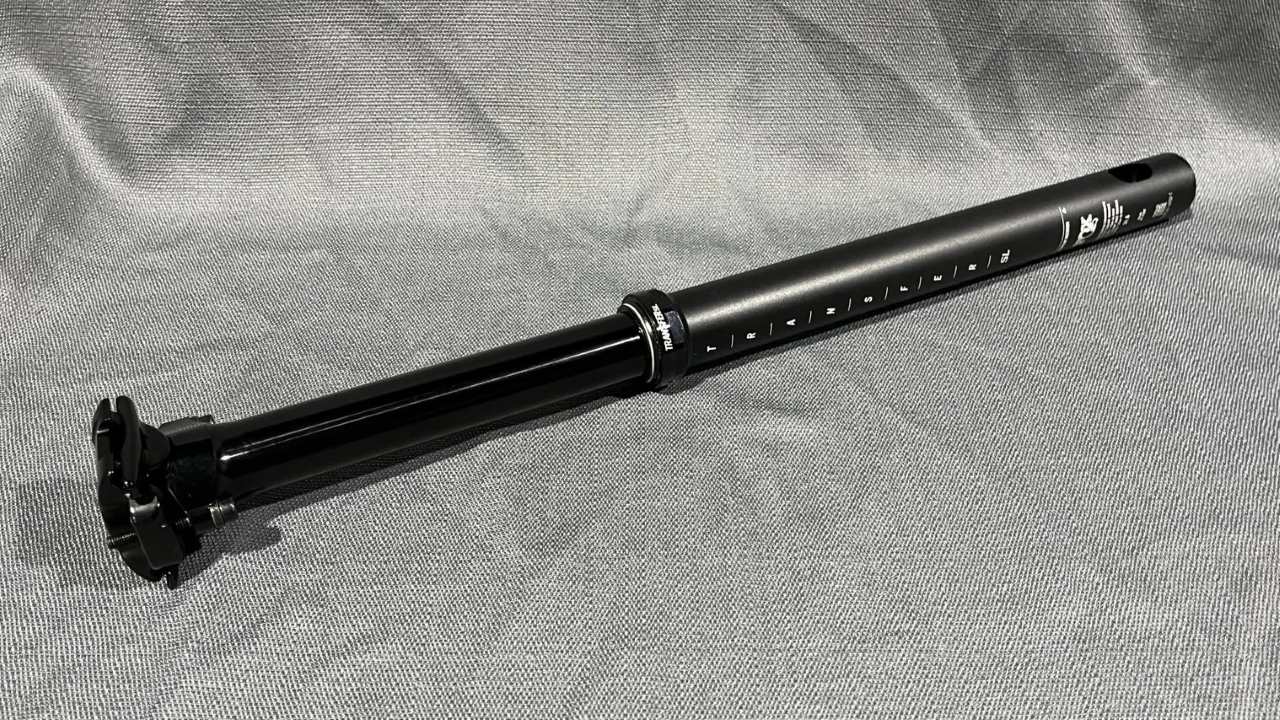
Dropper Post Service: How a Telescopic Seatpost Works
A dropper post is a seatpost you lower and raise while riding by pressing a lever on the handlebar. A lowered saddle frees up room for your body on descents and lets you get into a proper attack position, while a raised saddle restores full pedalling efficiency on climbs. On most models there is a sealed cartridge inside the post filled with oil and pressurised air: the lever opens a valve, you push the saddle down with your body weight, and the air pressure sends it back up when you open the valve again.
Mechanical dropper (cable actuation)
The most common type on modern MTBs. The lever on the handlebar pulls a steel cable through the housing, and the cable opens the valve on the cartridge. It is easy to maintain, but it is sensitive to the condition of the cable, the housing and how it is routed through the frame.
Hydraulic dropper (oil actuation)
Instead of a cable, the lever pushes oil through a hose, much like a hydraulic brake. Older generations of some popular models use this system. Actuation is smooth, but the system occasionally needs bleeding.

Wireless dropper
The lever sends a signal to a motor in the head of the post, with no cable or hose. Installation is the simplest, but a wireless dropper depends on a battery and electronics, so diagnosis is different.
| Dropper type | Actuation | Most common problem | Maintenance |
|---|---|---|---|
| Mechanical | Cable and housing | Stretched or dirty cable, poor housing routing | Cable, housing, cleaning the stanchion |
| Hydraulic | Oil through a hose | Air in the actuation system | Occasional bleeding |
| Wireless | Electronic signal | Flat battery, lost pairing | Charging the battery, cleaning the stanchion |
5 Most Common Dropper Post Faults and Their Causes

1. The dropper sinks when you sit down
The saddle is up, but the moment you sit, the post slides down a few centimetres. This is the most common complaint about droppers, and a sinking dropper post almost always means air has got into the oil chamber of the cartridge. Adjusting the cable won't help here. Depending on the model, the fix is a cartridge service (bleeding) or a replacement cartridge.
2. Slow return or doesn't extend fully
The usual causes are dirt on the stanchion, dry or worn seals, and a seat tube clamp that is too tight and literally squeezes the body of the post. On models with an air valve, low pressure can also be the reason. In the cold every dropper is a little slower because the oil gets thicker. If your dropper post is not returning at all, work through the cable and clamp checks below before assuming the worst.
3. Won't stay down or moves by itself
If the dropper rises on its own or won't hold the set height, the cable is most likely too tight and keeps the cartridge valve slightly open all the time. A housing that is too short gives the same symptom, because the cable gets pulled when you turn the handlebar.
4. No response to the lever
The lever goes all the way, but the dropper doesn't move. The cause is usually a loose or stretched cable, a dirty or damaged housing, or a cable that has come loose at the dropper end. On wireless models, check the battery first.
5. Side play and a wobbly saddle
If you can move the saddle left-right or forward-back relative to the frame, the sliders and bushings inside the dropper are worn. A small amount of play is normal on many models, but once you notice it while riding, it needs servicing. Lubrication only hides this problem temporarily.
What You Can Check Yourself
Before you book a dropper post service, these five checks solve a large share of problems on mechanical droppers:
- Check the cable tension. The cable shouldn't be slack, but also not so tight that it holds the valve open. Lower the dropper, release the lever and check whether the post moves without you pressing the lever. Fine-tune the tension with the barrel adjuster on the lever.
- Inspect the housing and its routing. Look for sharp bends, cracks and places where the housing rubs on the frame. Turn the handlebar fully left and right: the dropper must not react. Read more in our guide to bike cables and housing, or let us handle a bike cable replacement for you.
- Clean the stanchion and wiper. After every muddy ride, wipe the exposed part of the post with a soft cloth. Don't aim a high-pressure jet at the seal.
- Check the frame clamp. An over-tight clamp slows the return of the dropper. Tighten it with a torque wrench to exactly the value specified by the frame manufacturer, as explained in the guide to bike seat adjustment.
- On a wireless dropper, charge the battery. If the dropper still doesn't respond with a full battery, repeat the lever pairing following the manufacturer's instructions.
If the problem remains after these checks, the cause is inside the post. You can also run your symptoms through our online bike fault diagnostics tool.
Professional Dropper Post Service: When You Need It
Sinking under load, side play and oil leaks all call for a full dropper post repair, which means taking the post apart. That takes specific tools, spare parts for the exact model and, on some models, equipment for bleeding the cartridge. The principle behind the seals and hydraulics is similar to that of suspension and fork service.
Minor service
Cleaning, wiper replacement and lubrication of the sliders. It cures a slow return and squeaking, and when done regularly it extends the life of the seals.
Full service
Complete disassembly, replacement of seals and bushings and, on models that allow it, cartridge service and bleeding. It fixes sinking and play.
Cartridge replacement
Some droppers have a sealed cartridge that cannot be serviced and is replaced as a whole. In that case, replacing the cartridge is a faster and more reliable solution than replacing the whole dropper.
Dropper post service: prices at MTB Evolution
- Dropper post installation: 30 KM
- Cable replacement: 6 KM
- Housing replacement: 6 KM
- Internal service (seals, bushings, cartridge): charged by labour, workshop hour 60 KM; you get the exact price after inspection
See all prices in the bike service price list.
How Often to Service a Dropper Post
| When | What to do |
|---|---|
| After every muddy ride | Wipe the stanchion and check that the dropper returns smoothly |
| Regularly during the season | Check the cable, housing and side play |
| Per the manufacturer's instructions, at least once a year | Minor or full service, depending on condition and model |
The exact dropper post service interval is listed in the manual for your model. Add the dropper to your bike maintenance schedule, together with the fork and rear shock. If you want to understand the whole system, our MTB suspension guide covers forks, shocks and maintenance.
Buying a New Dropper Post: Travel and Diameter
If your dropper is damaged or you are only planning to fit one, check the following before you buy:
- Diameter: the most common are 30.9 mm, 31.6 mm and 34.9 mm. The diameter must match the frame exactly and is usually printed on your existing seatpost.
- Travel: depends on the length of your legs and on how deep the post can go into the frame. Measure your saddle height and the maximum insertion depth before buying.
- Cable routing: modern frames use internal routing, so choose a model whose cable enters at the bottom of the dropper.
- Lever: make sure the lever can be mounted next to your brake lever and shifter without interference.
Dropper sinking, slow to return or showing play? Book a dropper post service: bring the bike in for inspection and you'll get an exact diagnosis and price before any work starts.
Book an appointmentDropper Post Service: How Often and What Exactly We Do
Regular dropper post service prevents most of the failures riders experience halfway down a descent. As a rule, the stanchion should be cleaned and lubricated after every muddy ride, and a bigger service done once a year, or more often if you ride a lot.
- Cleaning and lubrication: wipe the lower stanchion, check the seals and apply a suitable lubricant.
- Cable and lever check: a tight or dirty cable is a common cause of return problems.
- Cartridge service: on hydraulic models the oil and seals are replaced, and the whole cartridge too if necessary.
Servicing is cheaper than replacing the whole post, so it pays to react to the first symptoms. If you don't know where the cause is, bring the bike to our bike service, book a slot through service booking or contact us with your questions. For more on maintaining forks and shocks, read the guide Fox shocks for bikes.
Sources and Further Reading
- Seatpost (Wikipedia) – types of seatposts, including telescopic ones
- FOX – suspension and dropper post manufacturer – specifications and manuals
Frequently Asked Questions
Why does my dropper post sink when I sit down?
Most often air has got into the oil chamber of the cartridge, so the post slides down under your body weight. Adjusting the cable won't fix it; a cartridge service or replacement will, depending on the model.
How much does dropper post service cost?
At MTB Evolution, installing a dropper post costs 30 KM and replacing a cable or housing costs 6 KM. Internal service is charged by labour (workshop hour 60 KM), and you get the exact price after inspection.
Can a dropper post be repaired, or does it need replacing?
Most faults can be fixed by replacing the cable, seals, bushings or cartridge. Replacing the whole dropper only makes sense when the stanchion or body of the post is damaged, or when parts for that model are no longer available.