A bike maintenance schedule isn't just about looks and a clean chain. It is a decisive factor for your safety, your performance on the trail and the lifespan of expensive components. The right routine can save you hundreds of marks a year in avoided breakdowns and replacement parts. As passionate riders and mechanics, working daily in our Evolution workshop, we all too often see top-end bikes ruined purely because basic service intervals were ignored.
In short:
- Prevention is key: a clearly defined bike maintenance schedule prevents costly failures on the trail.
- M-Check before every ride: a quick check of tires, brakes and handlebar can save your head.
- Clean is half the job: regular washing and lubing of the drivetrain can make your cassette and chain last up to 3 times longer.
- E-bike specifics: electric bikes need extra attention to software and battery contacts.
- The professional touch: once a year your bike deserves a detailed inspection in a certified workshop.
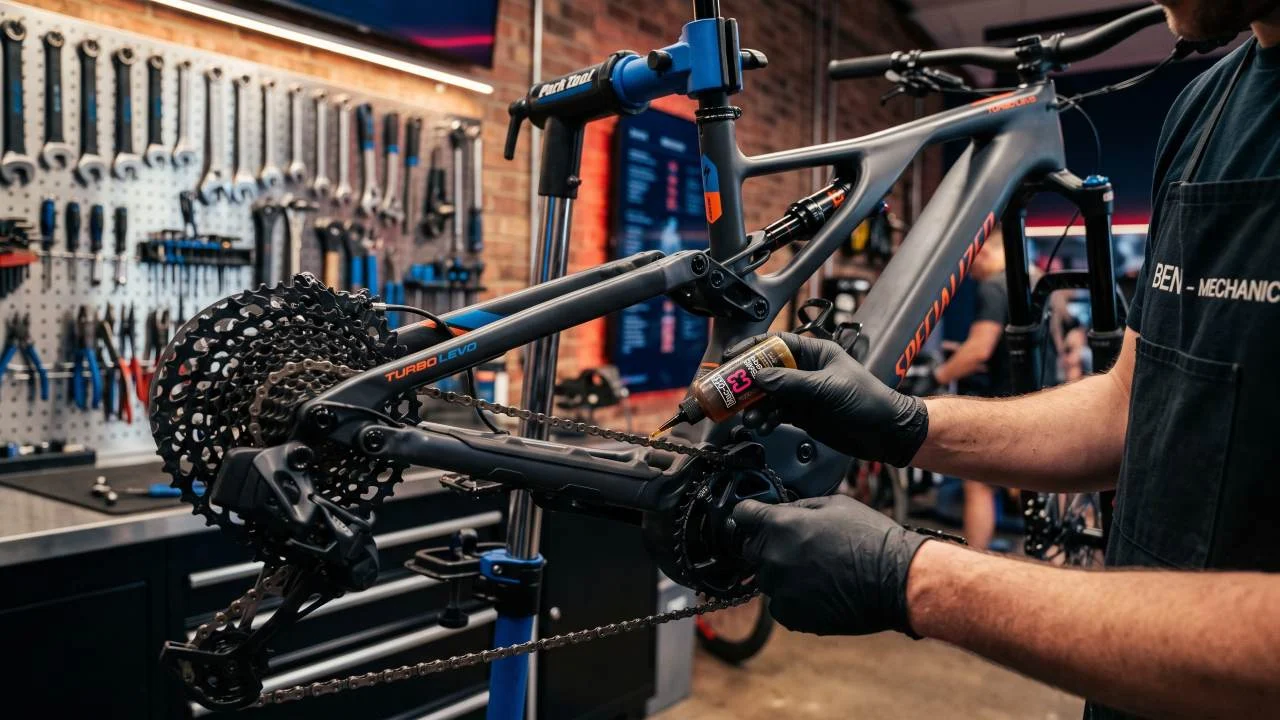
Bike Maintenance Schedule: Let's Start at the Beginning
There is no single calendar that fits everyone, because intervals change with how much you ride, the terrain (mud, dust, asphalt) and the type of bike you own. Still, the golden rule of mechanics splits upkeep into three basic phases: before every ride, monthly maintenance and the big annual service. Use the table below as a simple bike maintenance checklist.
| Interval | What to do | Who does it |
|---|---|---|
| Before every ride | M-Check: tires, brakes, axles, chain (2 minutes) | Rider |
| Monthly or every 150–200 km | Wash the drivetrain, measure the chain, check bolts, clean the suspension | Rider |
| Every 100–150 km | Lube the chain (and after rain and mud) | Rider |
| 50–100 hours of riding | Suspension service (oil and seals) | Workshop |
| Once a year | Brake bleeding, bearings, wheel truing | Workshop |
1. Before every ride (the quick M-Check)
This is your "preflight" routine. We call it the M-Check because your hands trace the letter "M" over the bike: from the front wheel up to the handlebar, down to the drivetrain, up to the saddle and back to the rear wheel. It takes exactly 2 minutes.
- Tire pressure: check your pressure (our tire pressure calculator will help). An overinflated tire bounces, while an underinflated one risks a "snakebite" (pinch flat) or rim damage.
- Brakes: spin the wheels and squeeze the brakes. They must bite sharply and never sink all the way to the grip.
- Wheel fasteners (thru-axle / quick release): make sure the axles are firmly closed.
- Chain: is it dry? If so, add a few drops of suitable lube and wipe off the excess with a rag. Not sure what to use? Read how to choose the right bike grease and oil.

2. Monthly maintenance (or after 150–200 km)
This is the phase of your bike maintenance schedule where your effort directly saves money. The goal is to remove the abrasive dirt that "eats" your components.
- Detailed drivetrain wash: use a degreaser and brushes to clean the chain, cassette and chainrings. A dirty chain wears out the whole drivetrain faster. Read more in our guide to the bike chain.
- Chain stretch check: a chain wear gauge costs little and saves a lot. Replacing the chain on time protects the cassette.
- Bolt check: take a torque wrench and check the bolts on the stem, seatpost clamp and cranks against the manufacturer's specifications (e.g. Park Tool repair help).
- Suspension cleaning: wipe the dust off the fork stanchions and the rear shock. Don't use aggressive degreasers near the seals!
A bicycle is an inherently quiet machine. If it starts to squeak, crunch or creak while you ride, that is absolutely not a sign you should stomp harder on the pedal. It is your bike crying out for love, cleaning and a little grease.
— Marko Ristivojević, Bosch Expert & Master Bike Mechanic
The Big Annual Service
Even if you are very meticulous with home upkeep, your bike needs a detailed inspection once a year, ideally at the end or the start of the season. If you wonder how often to service a bike, this is the one fixed point in any bike maintenance schedule. Complex systems such as hydraulic brakes and air suspension require special tools and know-how.
In our professional workshop, the annual inspection includes:
- Brake bleeding: replacing brake fluid that gradually absorbs moisture or air. See our hydraulic brake service.
- Suspension service: replacing the oil and seals in the fork and rear shock (usually recommended every 50 to 100 hours of riding).
- Bearing lubrication: disassembling, cleaning and greasing the wheel hub bearings, bottom bracket and headset.
- Wheel truing: checking spoke tension and straightening out "wobbles". Details are on our wheel truing page.

Maintenance Schedule for E-Bike Riders
Electric bikes are a revolution, but they also add new items to your bike maintenance schedule. Because of the extra weight and motor torque, the drivetrain and brakes wear out much faster. As a certified Bosch eBike Expert center, we stress the importance of regular firmware updates to optimize the battery and motor, and of cleaning the battery contacts to avoid system errors. Good e-bike maintenance also means looking after the pack itself, so see our guide to e-bike battery maintenance. We described the most common mistakes in e-bike maintenance mistakes, and our services in e-bike service.
Is it time to service your bike? Don't wait for a breakdown on the trail.
Book your service onlineFrequently Asked Questions
How often should I lube my bike chain?
As a rule, lube the chain every 100–150 km, and always after riding in rain, mud or deep dust. Always wipe off the excess oil with a dry rag before you ride.
Can I do the annual bike service at home myself?
Basic jobs such as changing tires, the chain or brake pads can be done yourself with basic tools. For air suspension service, bleeding hydraulic brakes and e-bike diagnostics, we recommend a properly equipped workshop.
What happens if I ignore a squeak from the drivetrain?
A squeak is usually a sign of dirt or a lack of grease, most often in the bottom bracket bearing or the pedals. Ignoring it leads to metal-on-metal friction, ruined bearings and a much more expensive repair.