Many riders wonder how to increase average speed on their rides. Average speed is a key number – it is easy to understand and a handy yardstick for your performance on the bike.
However, plenty of variables affect it. Comparing your speed with another rider's – or even with your own from one day to the next – isn't always helpful, especially on the varied terrain we have in Bosnia and Herzegovina.
Still, we all want to go faster. When the legendary Fausto Coppi was asked how to become a champion, he reportedly answered: "Ride your bike, ride your bike." That maxim from the 1950s still holds, but there are more ways to increase average speed than simply piling on kilometres.
Here are 15 expert tips to help you ride faster, more efficiently and smarter, on the road or on the trail.
1. What Is a "Good" Average Speed, Really?

As always, it depends. It depends on the bike you ride (a road bike with thin tires is faster than an MTB with knobby tires), but also on the terrain. The hilly terrain around Sarajevo or Romanija will drastically lower your average compared with riding on the flats in Posavina.
For beginners on a road bike, 25 km/h is a solid goal. To increase average speed all the way to 32 km/h (20 mph), you need serious, systematic training, because air resistance rises exponentially.
Technique and Handling: How to Increase Average Speed Through Skill
Every time you brake, you "throw away" energy you have put in. Avoid unnecessary braking. If you see a clear line through a corner or roundabout, hold your line and your speed. Safety comes first, but smooth riding saves power.
On rolling terrain, the speed you carry off a descent helps you tackle the start of the next climb. Get into an aero position (tuck) instead of pedalling in thin air at high speed. Rest your legs for the climb.
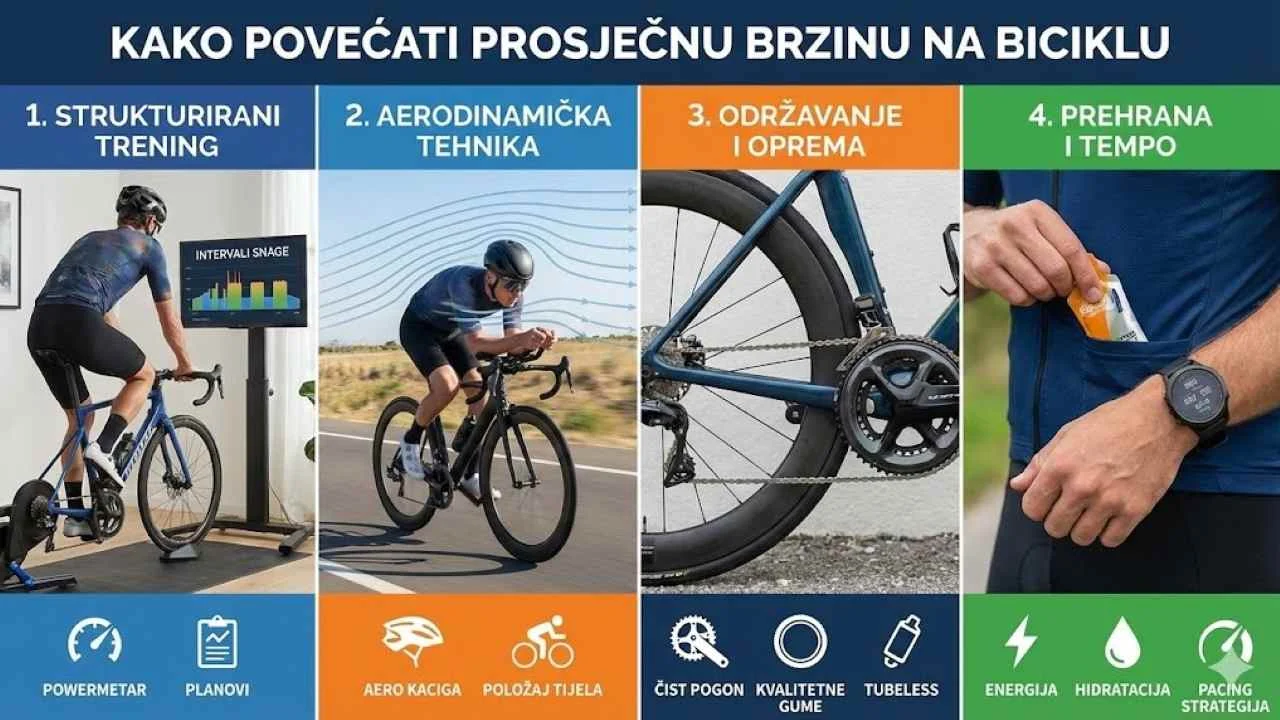
Around 75% of air resistance comes from you, not from the bike. You don't have to buy expensive aero wheels – just drop your elbows, lean toward the handlebar and make your silhouette smaller. Riding with your hands on the hoods and elbows bent is often faster and more comfortable than riding in the drops.

The Power of the Group and Your Gear

Riding in someone's slipstream (drafting) can save up to 40% of your energy. Join a local cycling club or group. When you are tired, tuck in at the back; when you feel fresh, come through for a turn on the front.
Poor shifting kills speed. Change to an easier gear before the climb gets steep, not after you have already stalled. Avoid "cross-chaining" (big chainring – big cog), because it creates friction and wastes watts.
Spin faster rather than pushing harder. The optimal cadence for most riders is 80-90 revolutions per minute. It loads your muscles less and your cardiovascular system more, which lets you hold a fast pace for longer. It is one of the simplest ways to increase average speed without buying anything.
Training and Strategy
If you are short on time, intervals are king. Try an "Over/Unders" session where you ride slightly above, then slightly below your FTP threshold. It dramatically improves your ability to tolerate hard effort. If you don't know your numbers yet, start with an FTP test and heart rate zones.
Even if you are a road cyclist, riding on gravel or in the woods improves your bike handling and pedalling efficiency. Many pro riders (like Pidcock) are top-level in both disciplines.

In Bosnia and Herzegovina we can't avoid hills. Hill repeats are the best way to get faster on them. Find a climb of a few minutes and ride it several times in a row.
Small Details That Add Up

Plan your route so that you fight the headwind while you are fresh (at the start) and let the tailwind push you home. Avoid open flats when the wind is strong.
Use a power meter or a bike computer. Strava Live segments can motivate you to push harder on specific sections, and the numbers show whether you really are able to increase average speed over time.
If you run out of energy (bonk), your average speed drops drastically. Take in about 60 g of carbohydrates per hour on longer rides and don't forget water. Dehydration of just 2% reduces performance.
Quality tires are the cheapest upgrade to increase average speed, so read our guide on how to choose bike tires. The right pressure is just as important – tires that are too hard slow you down on rough asphalt because they bounce.
A dirty chain creates friction and wastes watts. Keep your drivetrain clean and lubricated – our bike chain maintenance guide shows how. Also check that your brake pads aren't rubbing against the wheel.
PRO TIP: Aero Clothing
If you wear a loose jacket that flaps in the wind, you act like a sail that slows you down. Closer-fitting clothing is one of the easiest ways to get "free speed".
Quick Wins: What to Do First
If you want to increase average speed without months of training, start with the things that cost little but make a noticeable difference.
- Tire pressure: the wrong pressure wastes power; set it according to your weight and the surface with the help of the tire pressure guide.
- Chain and drivetrain: a clean, lubricated chain wastes less energy, and a worn chain costs the rider speed.
- Riding position: a small adjustment of the saddle or handlebar can reduce drag and improve comfort.
- Group riding: in another rider's slipstream you save up to a third of the effort.
- Even pace: less braking and fewer sudden accelerations means a higher average speed.
Realistic Expectations
It is realistic to increase average speed by 1 to 2 km/h over a season with regular training and a well-maintained bike. Don't compare yourself with riders on different terrain; measure yourself month by month. For a pre-season check-up, visit the bike service, and for a training plan read about the key areas of cycling training.
Sources and Further Reading
- Bicycle performance (Wikipedia) – the physics of speed and resistance
- Cycling power meter (Wikipedia) – measuring power
Frequently Asked Questions
Want to Progress Faster?
Join our group rides or book a bike service to keep your bike in top condition.
Join the Club