Which smart trainer to buy depends on three things: your budget, how often you train and what bike you ride (MTB, gravel or road). For most riders the answer is a direct drive trainer in the range of roughly 400 to 550 euros. This guide explains how to reach that choice without paying for features you do not need, and it pays special attention to mountain bikes, because that is where problems with the axle and the freehub most often appear. Prices and models reflect the situation in November 2026, so check them with the seller before you buy.
In short:
- A direct drive trainer measures power with an accuracy of about 1 to 2 percent and a wheel-on trainer with 3 to 5 percent, so for regular training the price difference is justified.
- When you ask which smart trainer to buy for most riders, the answer sits in the range of about 400 to 550 euros: JetBlack Victory, Van Rysel D500, Zwift Hub One or Wahoo KICKR CORE 2.
- To get into indoor training, the Van Rysel D100 (about 270 euros) is enough, but it is limited to 600 W and a 6 percent gradient.
- If you ride an MTB, check the rear axle (most often 12x148 mm) and the freehub type before buying; a Zwift Cog solves most cassette problems.
- The trainer is not the only cost: count a fan, a mat, a cassette and an app subscription, because that is the only way to know which smart trainer to buy within a real budget.
Which smart trainer to buy: direct drive or wheel-on?
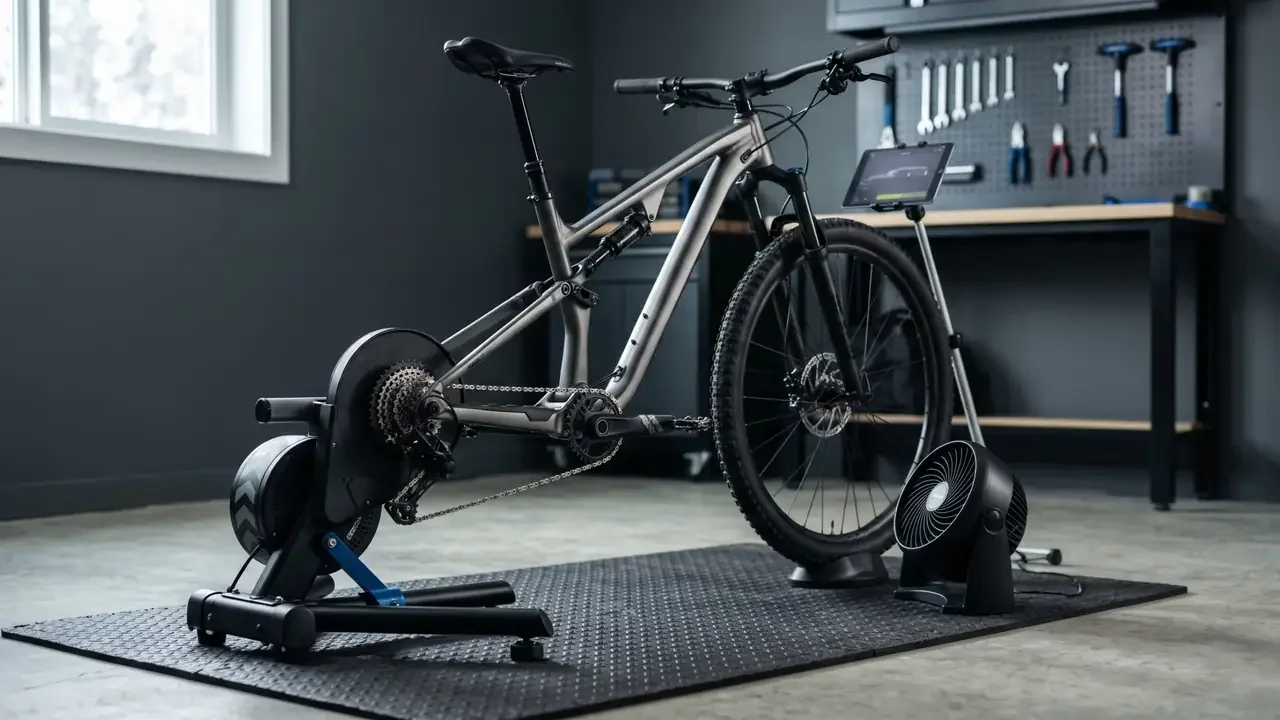
The first decision is the type of trainer, and everything else follows from it. Smart trainers fall into two groups: those that use your rear wheel (wheel-on) and those that replace it (direct drive, also called wheel-off). When you are choosing which smart trainer to buy, this is the difference you feel most in every ride.
Direct drive trainer: when it pays off
With a direct drive trainer you remove the rear wheel and put the chain on a cassette mounted directly on the trainer. There is no friction between the tyre and a roller, so there is no tyre wear and no slipping. Power measurement is more accurate, the trainer is quieter, and the ride feels more realistic because a heavy flywheel simulates the inertia of the bike.
Price is no longer the obstacle it used to be. Direct drive models now start at about 270 euros, and most good ones are between 400 and 550 euros. If you train more than twice a week, this is the right choice.
Wheel-on trainer: when it is enough
A wheel-on trainer is set up without removing the wheel, so it is the simplest way to start and is often cheaper (smart models start at about 300 dollars). The downsides are more noise, faster tyre wear and a power accuracy of 3 to 5 percent, because tyre pressure and roller pressure affect it. It makes sense if you ride only occasionally, if you just want to find out whether indoor training suits you, or if you do not want to take the wheel off.
| Feature | Direct drive | Wheel-on |
|---|---|---|
| Power accuracy | about ±1 to 2% | about ±3 to 5% |
| Noise | lower, about 5 to 10 dB difference | higher, the tyre on the roller adds noise |
| Tyre wear | none, the wheel is removed | yes, a trainer tyre is recommended |
| Ride feel | more realistic, heavier flywheel | weaker |
| Setup | wheel comes off, a matching cassette is needed | simple, the bike stays whole |
| Approximate price | from about 270 to 850 euros | from about 300 dollars |
What to check before you decide which smart trainer to buy
The specifications on the box look confusing, but only a few numbers really change the experience. Here is what to look at when you decide which smart trainer to buy.
Power accuracy
For recreational and amateur riding an accuracy of ±2 percent is enough. That is the value Wahoo states for the KICKR CORE 2, and independent tests show it matches well with the readings of power meter pedals. The difference between ±1 and ±2 percent only matters to riders who run calibrated FTP protocols at a competitive level.
Maximum power and gradient
Most models in the class up to 550 euros give about 1800 W of resistance and simulate a gradient of up to 16 percent. That is more than enough for intervals and climbs in virtual worlds. Larger ranges (2200 W and a gradient of up to 25 percent, as on the Tacx NEO 2T) are for sprinters and riders who like steep sections, but they cost considerably more.
Noise
If you train in an apartment, noise matters more than gradient. Direct drive trainers are quieter than wheel-on models, and the Tacx NEO and the Saris H3 (about 59 dB) are listed among the quietest. Use a thick mat under the trainer, because vibrations travel through the floor to your neighbours.
Connectivity and apps
Look for a trainer with Bluetooth FTMS and ANT+ FE-C protocols. It will then work with Zwift, Rouvy, TrainerRoad and most other apps. The Zwift Hub One has virtual shifting that works only in Zwift, which is an advantage if you use only that app and a limitation if you want to switch between apps.
Rider weight and stability
Check the maximum rider weight. The KICKR CORE 2 supports up to 113 kg. A wider leg spread gives more stability when you stand up out of the saddle, which matters for sprint intervals.
Smart trainer for MTB: axle, freehub and brakes
Most advice about trainers is written for road bikes, and an MTB has its own traps. A smart trainer for MTB has to match the rear axle and the type of freehub on which the cassette sits.
Modern mountain bikes most often have a 12x148 mm rear axle (Boost). The Wahoo KICKR CORE 2 supports a 130/135 mm quick release, 12x142 mm and 12x148 mm axles, and the adapters are in the box. Before you buy any other model, check that its compatibility list covers your axle.
The second problem is the cassette. A trainer comes either with a cassette already mounted (the KICKR CORE 2 has an 11-speed 11-28) or in a Zwift Cog version, which has a single sprocket and works with drivetrains from 8 to 13 speeds. If your MTB has a 12-speed drivetrain with an XD, XDR or Micro Spline freehub, a standard Shimano HG freehub on the trainer will not take your cassette. In that case the Zwift Cog is the simplest solution, because you do not have to buy or swap a cassette.
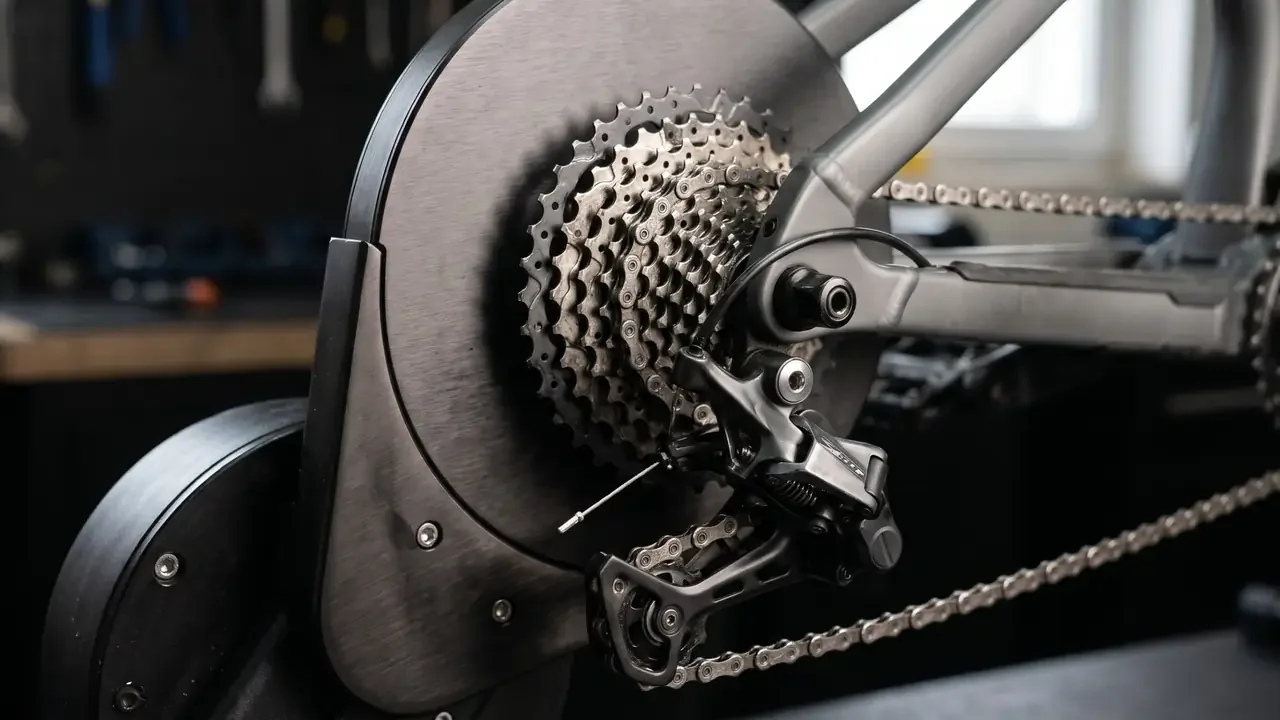
A direct drive trainer does not wear tyres, so your tyres stay untouched. The drivetrain is what wears the most: the chain and cassette work under more load on a trainer than outdoors, and sweat speeds up corrosion. Before the winter season clean and lubricate the chain following the guide to how to lube a bike chain, and if you are not sure about the state of the drivetrain, have it checked at the bike service.
Model overview: which smart trainer to buy by budget
The table shows the direct drive models most often recommended in 2026, ordered by price. Prices are approximate, in euros, and depend on the seller, promotions and what is included (cassette, Zwift Cog, subscription), so check them before you buy.
| Model | Price (approx.) | Max. power | Max. gradient | Accuracy |
|---|---|---|---|---|
| Van Rysel D100 | 270 € | 600 W | 6% | about ±5% |
| JetBlack Victory | 400 € | 1800 W | 16% | ±2% |
| Van Rysel D500 | 400 € | 1500 W | 15% | not stated |
| Zwift Hub One | about 500 €, one year of Zwift included | 1800 W | 16% | ±2.5% |
| Wahoo KICKR CORE 2 | 550 € | 1800 W | 16% | ±2% |
| Tacx NEO 2T | 850 € | 2200 W | 25% | not stated |
For a beginner: Van Rysel D100
The cheapest direct drive entry, at about 270 euros. Power of 600 W and a gradient of up to 6 percent are enough for light training and recovery rides, but not for threshold intervals or steeper sections in an app. It is a good choice if you want to find out whether you will ride indoors at all.
For most riders: which smart trainer to buy in the class up to 550 euros
The KICKR CORE 2 is the most often recommended direct drive trainer for most riders because of its balance of accuracy, ride quality, compatibility and price. If price matters more, the JetBlack Victory (about 400 euros) offers the same main specifications, and the Van Rysel D500 is a solid choice with a Zwift Cog for about 400 euros. The Zwift Hub One is a good option if you ride almost exclusively in Zwift and want virtual shifting.
For demanding training: Tacx NEO 2T
If you train almost every day and want the most realistic feel, the NEO 2T is the top of this overview, with 2200 W and a gradient of up to 25 percent. The difference compared with the 550 euro model shows in ride quality, not in more usefulness for the average recreational rider.
Mistakes people make when choosing which smart trainer to buy
The same mistakes repeat when deciding which smart trainer to buy, and almost all of them can be avoided if you check before paying.
- Looking only at the price: the price of a bike trainer is only the start of the calculation. If you have to buy a cassette, an axle adapter or a subscription separately, a cheaper model can end up costing more than one that comes with everything you need.
- Buying by maximum power: 2200 W looks impressive, but a recreational rider rarely exceeds 1000 W even in a sprint. For most riders 1800 W is a reserve that is never used.
- Ignoring the axle and freehub: a trainer that does not fit your bike stays in the box. On an MTB this is the most common reason for returns.
- Ignoring noise: in an apartment or a house with a thin floor the best trainer is the one you can use at any time of day.
- Tying yourself to one app: a smart trainer for Zwift does not need a Zwift logo. Any model with Bluetooth FTMS or ANT+ FE-C works in other apps too, so there is no need to lock yourself into one ecosystem if you do not want to.
What else you pay for with a smart trainer
When you work out which smart trainer to buy, do not count only the price of the box. The real cost includes a few more items:
- Fan: you sweat much more indoors than outdoors, and without airflow you overheat faster.
- Mat and sweat protection: they protect the floor and reduce vibration, and a towel over the handlebars protects the frame from sweat.
- Cassette or Zwift Cog: some direct drive models come without a cassette, so it has to match the number of gears on your bike.
- App subscription: the Zwift Hub One includes a year of subscription, while with other models the subscription is paid separately.
- Device for the app: a computer, tablet or phone with a good Wi-Fi connection.
Once you decide which smart trainer to buy and get it, setup and first rides are described in the Zwift indoor cycling guide, including calibration and a winter training plan.
Before your first week on the trainer, have the chain, cassette and bearings checked, because indoor riding loads the drivetrain more than riding on a trail.
Book an appointmentConclusion: which smart trainer to buy
If you keep only one rule, let it be this: buy direct drive if your budget allows. For most riders that means a model of about 400 to 550 euros with 1800 W, a gradient of up to 16 percent and ±2 percent accuracy. For an MTB, check the axle and the freehub type before paying, and whichever brand you end up with, choose the one with good support for the app you use. You can check the specifications and availability of the KICKR CORE 2 on the Wahoo model page.
Frequently asked questions
Which smart trainer to buy for a beginner?
For a beginner who is just trying indoor training the Van Rysel D100 (about 270 euros) is enough. If you know you will ride regularly, it is better to go straight to a direct drive model of about 400 to 550 euros, such as the JetBlack Victory, Zwift Hub One or Wahoo KICKR CORE 2, because you will need more power and gradient.
Is a direct drive trainer better than wheel-on?
Yes, for regular training. Direct drive measures power more accurately (about 1 to 2 percent versus 3 to 5 percent), is quieter, does not wear out a tyre and gives a more realistic ride feel. Wheel-on is cheaper and simpler to set up, so it is good for occasional riding.
Which smart trainer to buy for an MTB?
For an MTB it matters more that the trainer fits the axle and freehub than which brand it is. Most mountain bikes have a 12x148 mm axle, which trainers such as the KICKR CORE 2 support, and if the bike has a 12-speed drivetrain with an XD, XDR or Micro Spline freehub, the easiest solution is a trainer with a Zwift Cog.