Bike lanes are a part of the road that many drivers and cyclists still misunderstand. Year after year the number of cyclists on our streets grows, whether they are commuting, training or just riding for fun. But as more two-wheelers appear on the asphalt, so do the conflicts between drivers and riders. The main cause? Not knowing the rules and the road infrastructure, especially when it comes to lanes and paths for bicycles.
The Law on the Basics of Road Traffic Safety in BiH (ZOOBS) defines our rights and obligations very precisely. To share the asphalt safely and with mutual respect, we need to clear up what the lines on the road actually mean and how to behave in different traffic situations. That is why, following our big guide to cycling in traffic, we decided to go deeper into the topic of cycling lanes and paths.
In short:
- Bike lanes and bike paths are not the same thing: A path is physically separated and mandatory to use, while a lane is part of the asphalt where the bicycle is an equal road user.
- Absolute priority in the lane: On narrow streets with a dashed line, the car must wait for the cyclist to pass.
- No sidewalks: Riding a bicycle on the pedestrian sidewalk is prohibited by law.
- Blind spot at junctions: A car turning right must give way to a cyclist going straight through the bike lane.
Bike Lanes and Bike Paths: Not the Same Thing
Although the terms are often mixed up in everyday speech, traffic engineering and the law keep them strictly apart. Let's clear up the terminology first:
- Bike path: A built surface that is physically separated from the roadway (by a curb, a green strip or a fence). It is intended exclusively for bicycles. Where a path exists, the cyclist is obliged to use it and must not ride on the roadway meant for cars.
- Bike lane: A part of the roadway itself (the asphalt) that runs along the right edge and is marked with a longitudinal line and a bicycle pictogram. Here the bicycle is an equal vehicle on the carriageway. Motor vehicles must not drive, stop or park in this lane.
| Question | Bike path | Bike lane |
|---|---|---|
| Position | Physically separated from the roadway | Part of the roadway along the right edge |
| Marking | Curb, green strip or fence | Longitudinal line and bicycle pictogram |
| Obligation to use | Yes, when it exists | The bicycle is an equal vehicle on the road |
| Cars | Must not enter the path | Must not drive, stop or park in the lane |
Lanes with a Dashed Line
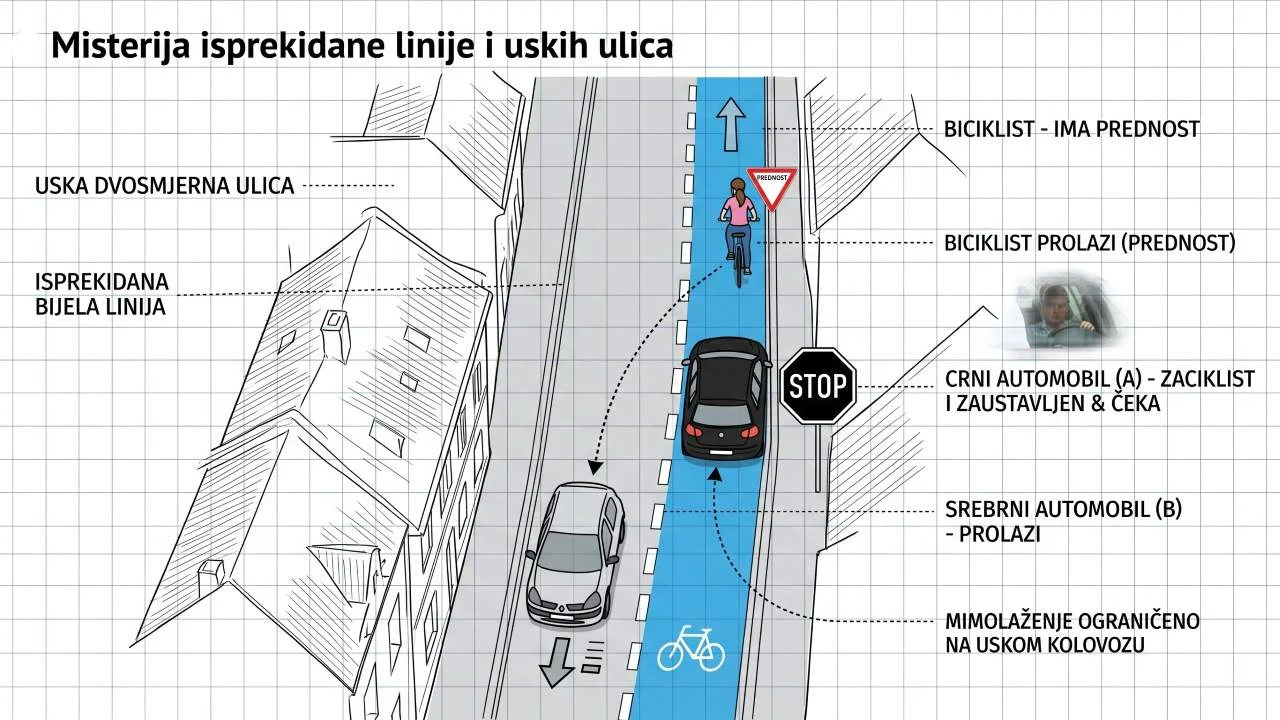
One of the situations that causes the most frustration out on the road is the narrow two-way street where bike lanes are separated by a dashed line and the rest of the roadway is not wide enough for two cars to pass safely. This design, known as a "suggestive bike lane", is not an engineering mistake but a deliberate traffic-calming solution.
- What the dashed line means: Unlike a solid line, which acts as a "wall", cars may cross a dashed line, but only to pass an oncoming vehicle safely.
- The cyclist has absolute priority: A car driver may enter the bike lane only if it is completely empty at that moment.
- No "squeezing": If another vehicle is coming towards the car and there is a cyclist in the lane on the right, the driver must slow down or stop completely. The car has to wait for the cyclist to pass and only then cross the line.
- The cyclist does not escape onto the sidewalk: Drivers often honk, expecting the bicycle to leave the asphalt and ride on the pedestrian path. Riding on the sidewalk is prohibited. The cyclist rides straight through the lane and has no obligation to move aside.
The street is not a place to prove strength, it is a public space we share. Visually narrowing the road with bike lanes makes drivers instinctively slow down, which makes the street safer for absolutely everyone.
— Marko Ristivojević

When There Is No Bike Lane: Riding on the Road
Unfortunately, the network of paths is often broken or non-existent, especially when you ride towards more rural areas or head to our Bike Park Evolution. When there are neither lanes nor paths, the bicycle takes the role of a regular vehicle with clear rules:
- One metre from the edge: The cyclist must ride as close to the right edge of the roadway as possible, and at most one metre from it. This space lets you avoid potholes or glass. Of course, safe riding assumes a technically sound bike, which is why we always recommend regular visits to our bike service. E-bike riders need to take special care in traffic because of the higher weight and speed, and we covered their legal status in detail in MTB and E-Bike Law in BiH (2026).
- Riding in single file: If several cyclists ride together (as the members of our cycling club do on training rides), they must ride one behind the other. Riding side by side is strictly prohibited because it endangers safety.
- Clear signalling: Every change of direction must be signalled in time with a clearly extended arm.
Junctions and the Blind Spot
Most incidents happen at junctions, especially when cars turn right. When a car turns right, its path inevitably crosses the line of the bike lane. The law is clear here: the car driver must give way to a cyclist who keeps going straight through the bike lane. This is the core of cyclist right of way at junctions.
The biggest danger here is the so-called "blind spot". Drivers of motor vehicles must check the right mirror and turn their head, while cyclists should ride defensively and never automatically assume the driver has seen them (especially trucks or buses). Teaching these habits early is part of our kids bike safety and road education programme.
Bike lanes only work when everyone understands them. Only through mutual respect and a good grasp of the road infrastructure can we reduce the number of accidents and make our streets more pleasant for everyone.

Safe riding in the city starts with a well-prepared bike. Book a check of your brakes, lights and drivetrain.
Book a service onlineFrequently Asked Questions
Is a cyclist allowed to ride on the sidewalk?
No. Riding a bicycle on the sidewalk, which is meant for pedestrians, is prohibited by ZOOBS in BiH. Cyclists use bike paths, bike lanes on the roadway or, if there are none, the right edge of the roadway.
Who has right of way when a car turns right across a bike lane?
The cyclist who continues straight in their lane has right of way. The driver turning right must check the blind spot and let the cyclist pass.
How do you ride properly in a group when there is no lane?
Several cyclists on the roadway must ride in single file, one behind the other, along the right edge. Riding side by side is prohibited because it makes safe overtaking harder.