Protocol: Fast and Safe Descending Technique
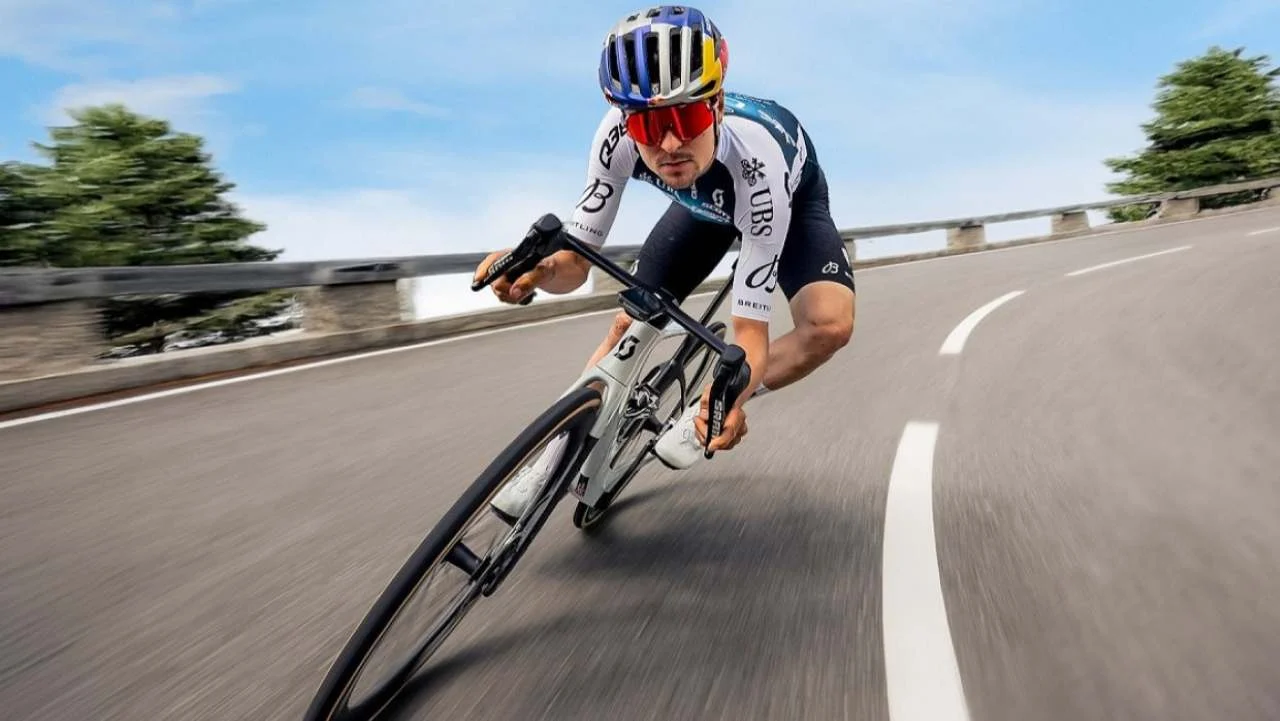
Goal: Build a descending technique that optimises aerodynamics, stability and line choice at speeds above 40 km/h.
This protocol defines the biomechanical basics you need to control a descent. Fast and safe descending technique comes down to proper weight distribution, aerodynamics and precise braking for maximum traction.
Glossary of technical terms
Why does fast and safe descending technique matter?
A descent is the "free speed" gravity gives us, but only if we know how to use it. Many riders give away the advantage they earned on the climb because of fear and poor technique on the way down. Proper descending technique not only makes you faster in races, it also drastically reduces the risk of serious injury at high speed.
The key isn't "crazy bravery", it's applying physics. Understanding how your centre of mass affects stability and how tyres react to lateral forces lets you ride with flow instead of riding in jerky, tense bursts.
1. Biomechanics: Body position on the descent
The right body position lowers your centre of mass and makes the bike more stable. This is the foundation of every good descending technique.
| Body segment | Position | Reason |
|---|---|---|
| Hands | Lower section (Drops) | Lower centre of gravity and better leverage on the brakes. |
| Elbows | Bent, close to the body | Improved aerodynamics and better vibration absorption. |
| Eyes | 20-30m ahead | Your brain needs time to process the line. |
| Pedals | Level (3 and 9 o'clock) | Stability on straights (or outside foot down in a corner). |
2. Braking protocol
- Force distribution 70% front / 30% rear. The front brake provides most of your stopping power.
- Body position Shift your hips back over the saddle to avoid going over the bars.
- Cooling (Heat Mng.) Don't drag the brakes constantly. Use "pulse" braking (squeeze-release) to cool the discs.
3. Cornering technique
Fast and safe descending technique shows most in the corners, where the biggest differences between riders appear.
Finish braking while the bike is still upright. Enter from the outside edge of the road.
Outside leg straight and loaded. Inside knee pointing into the corner.
Pass through the tightest point without braking. Drive hard on the exit.
4. Nutrition and focus
Descending demands extreme concentration. A drop in blood sugar slows your reflexes.
Take in 15-20g of fast carbs (gel) at the top of the hill, before you start down.
Wind chills you. Put on a wind vest (gilet). Cold muscles lose precision.
5. Common mistakes that slow you down
Analysing your mistakes is part of mastering descending technique, and it's the quickest way to learn how to descend faster. Avoid these three traps:
-
Braking at the apex This stands the bike up and pushes you off the ideal line. Brake *before* the corner, not *in* it.
-
Target Fixation Staring at the obstacle you want to avoid (like a pothole) almost guarantees you'll hit it. Look where you want to go.
-
A stiff body If you fight the bike, you lose traction. The bike has to "dance" beneath you while you stay stable.
Pro Tips for fast descents
- Inside pedal UP: Always keep the inside pedal at 12 o'clock while leaning. Clipping a pedal on the ground at 50 km/h is catastrophic.
- Focus on the exit: The bike goes where you look. Don't stare at the pothole or the verge, look at the corner exit.
- Relaxed hands: Don't strangle the bars with a "death grip". Let your forearms soak up the micro-bumps in the asphalt. That's the essence of good descending technique.