FOX VS ROCKSHOX
Side-by-side guide:

FOX and RockShox forks for mountain biking
FOX vs RockShox is the question MTB enthusiasts ask most often when choosing a fork. In this MTB fork comparison we look at the most popular models, their features and what they are built for, so you can make the right call.
“Which is better – FOX or RockShox?” These are the two leading brands in MTB suspension, and choosing between them is not always simple. We will compare their features, performance tiers, technology, history and popularity among riders and racers.
🛠 Basics and history
RockShox was a pioneer of MTB suspension, launching the first production fork back in 1989.
FOX Racing Shox appeared later, in 2001, but quickly became a byword for quality and performance.
Today both brands offer a wide range of forks, from light XC models to robust long-travel downhill forks. Although they differ in approach and in some details, both manufacturers compete at the very top level of the sport, in the XC and DH World Cup.


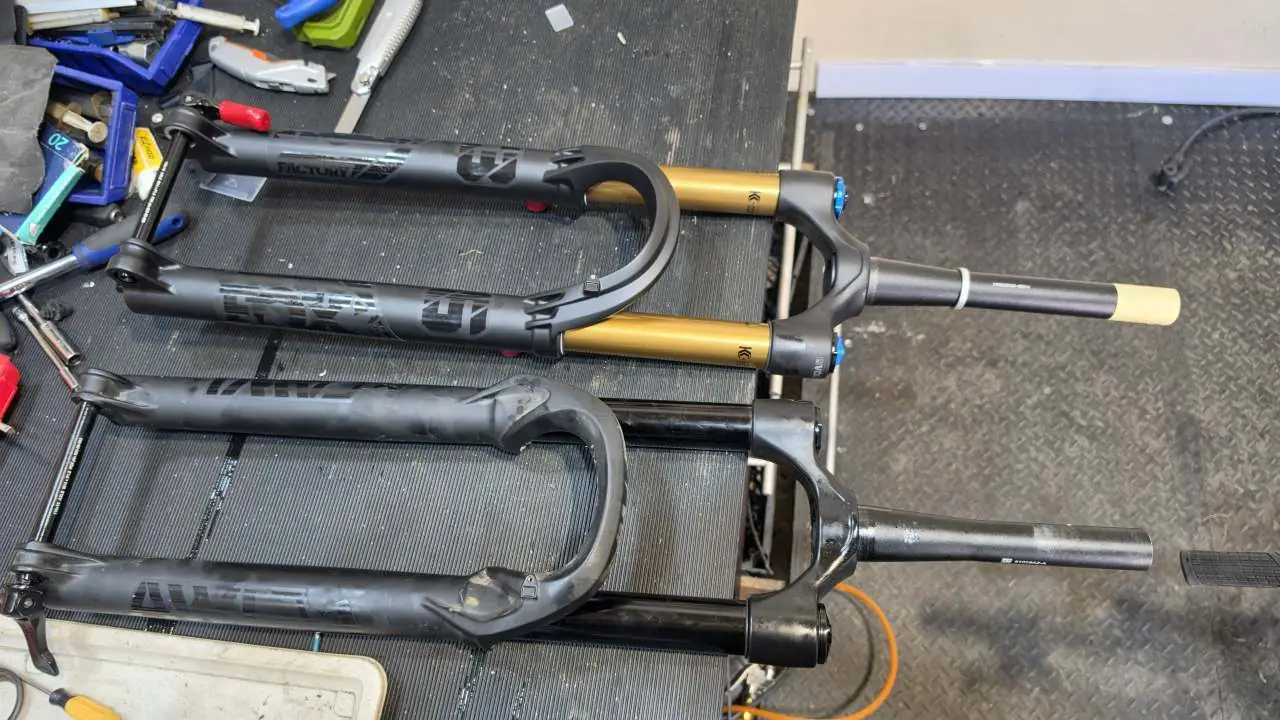
🔍 Model hierarchy compared
| Tier | FOX | RockShox |
|---|---|---|
| Entry | Rhythm, Performance | Select |
| Mid | Performance Elite | Select+ |
| Top | Factory | Ultimate |
FOX names its models after the stanchion (fork leg) diameter: FOX 32, 34, 36, 38 and 40.
RockShox uses different names for different models: SID, Pike, Lyrik, Zeb, BoXXer and so on.
🏁 Forks by riding style
Cross-country (XC)
FOX: 32 Step-Cast, 34 Step-Cast
RockShox: SID SL, SID, Reba, Recon
Suspension travel: 100–120 mm
XC forks are light and optimized for efficiency on climbs and flats.
Trail
FOX: 34
RockShox: Pike, Revelation, 35
Travel: 120–150 mm
Built for versatile riders – a mix of control, comfort and agility.
Enduro
FOX: 36, 38
RockShox: Lyrik, Yari, Zeb
Travel: 150–180 mm
For aggressive descending with solid climbing ability.
Downhill (DH)
FOX: 40
RockShox: BoXXer
Travel: 180–200 mm
Dual-crown forks with maximum stiffness and impact absorption.
⚙️ Technology and performance
Dampers
FOX: FIT GRIP, FIT4, FIT GRIP2
RockShox: Charger, Charger 2.1, Rush RC, Motion Control
Higher tiers offer more adjustability and better absorption on technical trails.
Stanchion coating
FOX: Black anodized or Kashima gold (on Factory models) – known for exceptional smoothness and longevity.
RockShox: Black anodized or Fast Black – a good balance between slickness and durability.
Stanchion diameter
FOX 32/34/36/38/40 mm
RockShox SID (32-35mm), Pike/Lyrik (35mm), Zeb (38mm), BoXXer (38mm)
A larger diameter means more stiffness and stability, which matters most on enduro and DH forks.
🔁 Maintenance and durability
FOX recommends a basic service every 30-50 hours of riding and a full service every 125 hours. See our Fox fork lower leg service guide.
RockShox has similar intervals, but it is known for being easier to maintain at home. Here is a RockShox lower leg service walkthrough.
For serious riders, regular maintenance is the key to a long service life and optimal performance.
🏆 Popularity and race results
In the World Cup:
XC races: RockShox SID dominates among many winners.
DH races: the FOX 40 is often the choice of top teams such as Santa Cruz Syndicate.
In sales, many bike shops report slightly higher demand for FOX forks, especially the Factory series, thanks to their looks (the Kashima coating) and high-quality finish.
✅ Conclusion: which fork should you choose?
In the FOX vs RockShox debate there is no universal answer. If you are looking for:
Luxury and maximum performance: FOX Factory
A balance of price and quality: RockShox Select+ or Ultimate
Easy servicing: RockShox
Looks and prestige: FOX (especially with the Kashima coating)
Both brands make outstanding products. In the end, the best MTB fork for you depends on your budget, riding style and personal preferences. Our best advice? Try both if you can and pick the one that suits you most!
FOX vs RockShox: how to choose the fork you need
In practice, the difference between the two brands is smaller than it seems. You will reach a decision more easily if you answer a few questions.
- Which discipline are you buying for? Travel of 100 to 120 mm for XC, 130 to 150 mm for trail, 160 to 180 mm for enduro and more for downhill.
- How thick are the legs? Thicker legs are stiffer but heavier; the choice depends on rider weight and riding style.
- Which axle and standard? Check the axle width and diameter, hub compatibility and the steerer tube.
- How big is the service network? Availability of service and spare parts is often more important than the brand.
- What is your budget? Higher-tier models bring better adjustability and lower friction, but a good mid-range model can be more than enough.
Service and setup matter more than the brand
The most expensive fork is no good if it is badly set up or has not been serviced. Before you shop for a new mountain bike suspension fork, set your SAG, rebound and compression using the MTB suspension tuning guide and service the one you already have. Also read our overview of Fox shocks for bikes. For fork servicing, visit our bike service, learn more about bike suspension service or book your bike service online. FOX vs RockShox is best decided after a test ride on the trail.
Sources and further reading
- FOX – suspension manufacturer – fork specifications
- RockShox – official website – fork specifications
Frequently Asked Questions
FOX vs RockShox: which fork is better?
There is no universal answer. Both brands compete at the highest level in the XC and DH World Cup. FOX Factory suits riders who want luxury and maximum performance, while RockShox Select+ or Ultimate offers a balance of price and quality, and RockShox is easier to service. The right choice depends on your budget, riding style and personal preferences.
How much travel do I need for my riding style?
In the comparison, XC forks have 100–120 mm of travel, trail forks 120–150 mm, enduro forks 150–180 mm and downhill forks 180–200 mm.
How often should I service a FOX or RockShox fork?
FOX recommends a basic service every 30-50 hours of riding and a full service every 125 hours. RockShox has similar intervals, but it is known for being easier to maintain at home.
What is the Kashima coating on FOX forks?
Kashima gold is a stanchion coating used on FOX Factory models. It is known for exceptional smoothness and longevity, and it also gives the fork a premium look.