E-bike spring maintenance is an essential step before your first serious rides after the winter break. An e-bike lets us explore trails and bike parks with ease, but it also brings a need for specific, expert care. Your electric bike is not just a mechanical machine. It is a system of sensors, software and a battery, so getting an e-bike ready after winter takes far more than pumping up the tires.
In short, from this guide:
- E-bike spring maintenance starts with a battery diagnostic and a software update, not with lubing the chain.
- An e-MTB is typically 8–12 kg heavier than a regular bike, so brakes and pads take a much bigger load.
- The motor delivers up to 85 Nm, so a worn chain can ruin your cassette and chainring within a few hundred kilometers.
- Never wash an e-bike with a high-pressure washer.
- Do a full service once a year and an inspection every 1,000–1,500 km.

People often think an e-bike is just a regular bike with a battery. The truth is that e-bikes are heavier, more powerful and more complex. The chain takes huge forces from the motor, and the battery needs a regular software check. A visual inspection in the garage is no longer enough.
— Marko Ristivojević, Bosch eBike Expert
In the Evolution workshop we see the results of poor winter storage every day. That is why we built a 5-point checklist that we run through on every e-bike.
E-Bike Spring Maintenance: 1. Battery and Software Diagnostics
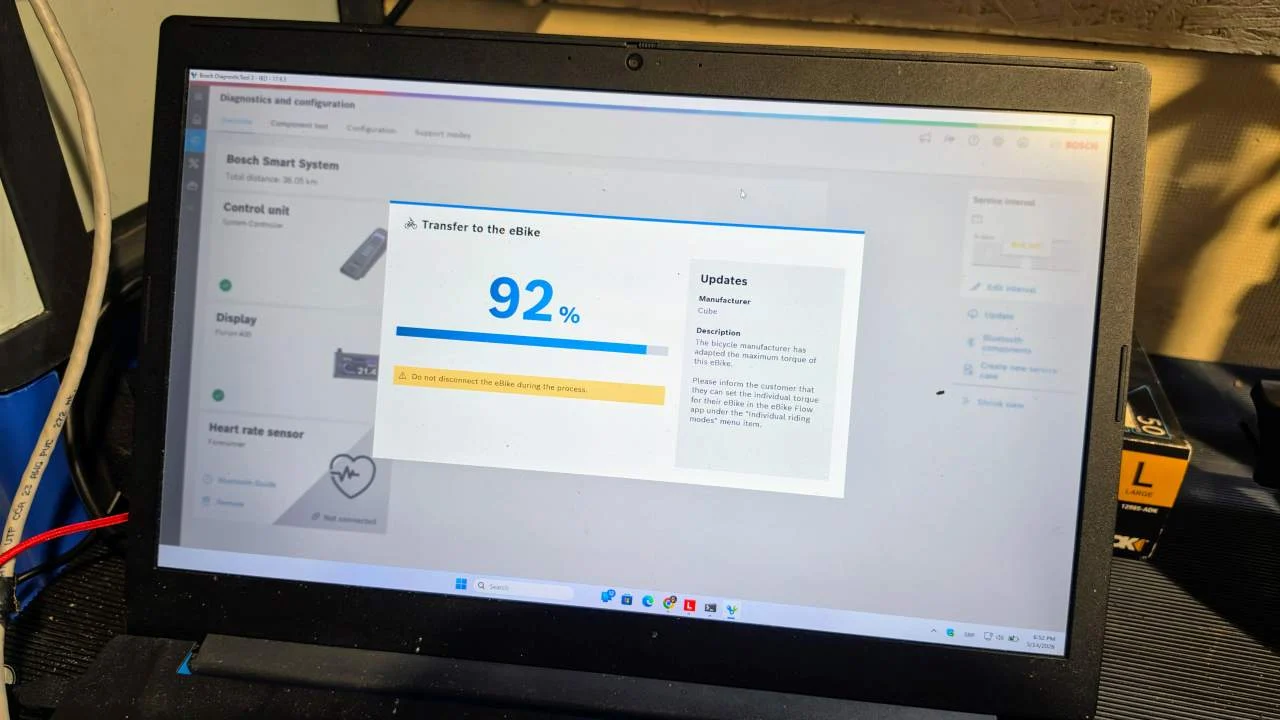
The first step is not lubing the chain. It is connecting to the diagnostic software. Unlike a purely mechanical repair, e-bike service begins by reading the errors stored in the system.
- Battery capacity: we check the number of charge cycles and the real "health" of the battery.
- Software update: manufacturers such as Bosch regularly release updates that optimize consumption and fix bugs.
- Sensor calibration: the speed and torque sensors must be in sync so the assistance feels natural.
To learn how to store your battery through the year, read our guide on e-bike battery maintenance.
2. Brakes and Heavy Weight
The average e-MTB is 8 to 12 kilograms heavier than a regular bike. Add the speed the motor reaches with ease, and it is clear why the brakes take extreme loads.
That is why the spring check includes rotor and brake pad thickness. We often recommend pads made for e-bikes, which dissipate heat better and wear more slowly. Bleeding hydraulic brakes after winter brings back a sharp, safe feel at the lever, and our hydraulic brake service covers exactly that.
3. Drivetrain: Chain, Cassette and Chainring
An e-bike motor can deliver up to 85 Nm of torque, and that force goes straight to the chain and cassette. A worn chain on an e-bike can destroy the cassette and front chainring in just a few hundred kilometers.
We measure chain stretch with a gauge and inspect the cassette teeth. Lubing with oil made for e-bikes gives quieter running and a longer life for these expensive parts. To see when it is time to replace them, check the guide on when to replace your chain and cassette.
4. Tires and Suspension After Winter
Good e-bike spring maintenance never skips the tires. After winter they are often flat, and on tubeless setups the sealant can dry out. Check the pressure and the tread condition, and top up the sealant before your first ride. If you need a refresher, here is how to set up tubeless tires.
The fork and shock should work smoothly and without oil leaks. Clean the stanchions and check your SAG and pressure, because the extra weight of an e-bike needs a bit more air than a regular bike. If something feels off, our suspension service can sort it out.
5. Washing an E-Bike Without Damaging It
Once your e-bike spring maintenance is done, all that is left is regular upkeep through the summer. If something still feels wrong, check these signs your e-bike needs service. For official information on systems, updates and the app, visit Bosch eBike Systems. A general spring check for a regular bike is covered in spring bike maintenance.
Ready for a safe spring ride? Leave your e-bike spring maintenance to our team: diagnostics, software update, brakes and drivetrain in one place, at our Bosch electric bike service.
Book a service appointmentFrequently Asked Questions
How often should an e-bike be serviced?
We recommend one full service a year, ideally as spring preparation, plus regular inspections every 1,000 to 1,500 kilometers, depending on terrain and riding style.
Can I update the Bosch software on my e-bike myself?
Bosch offers some updates through its app, but the complete system diagnostics, updating and clearing of errors is done by a workshop with the licensed Bosch DiagnosticTool.
Does winter damage an e-bike battery?
It can. Low temperatures damage lithium-ion cells, so keep the battery at room temperature over winter, charged to around 60%.