Protocol: MTB Switchbacks – Surgical Precision
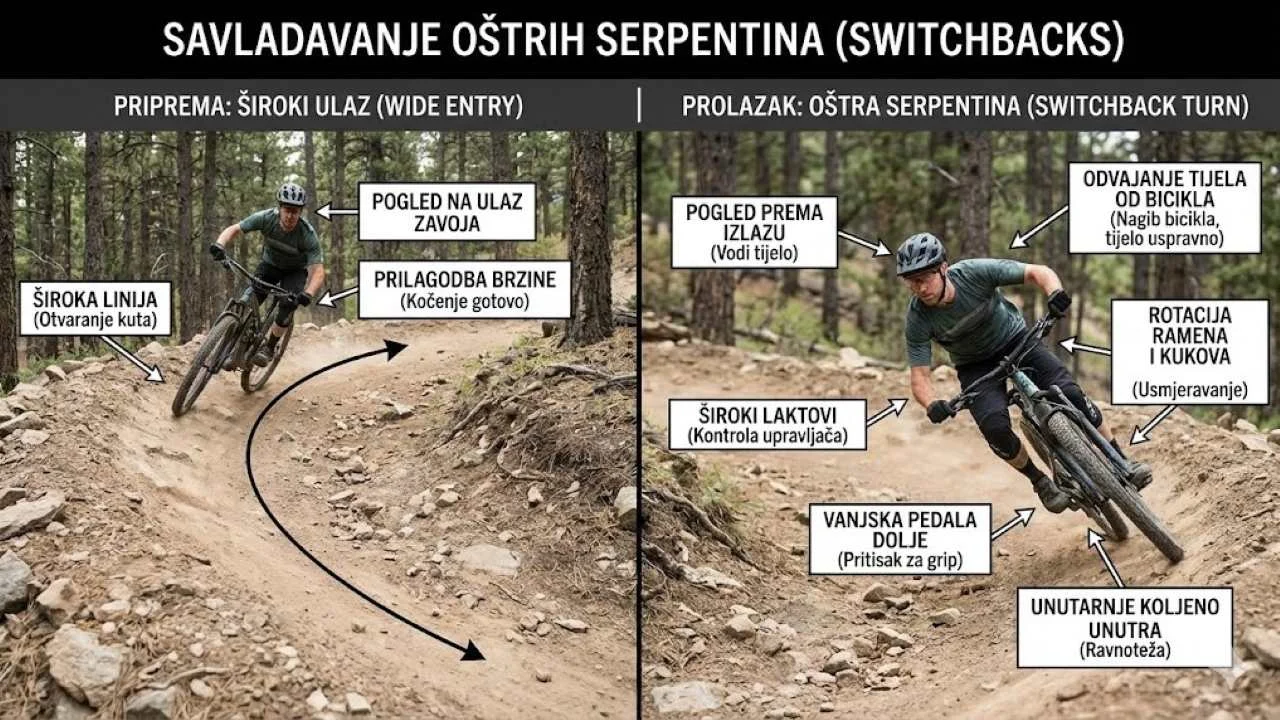
Goal: Master 180° MTB switchbacks on steep terrain while keeping your momentum and traction.
There is no room for error in a tight switchback. The space is narrow and the gradient is steep. The secret to how to ride switchbacks well lies in a radical hip rotation (Hip Swivel) and the ability to lean the bike independently of your body (Counter-balance).
Advanced Terms Glossary
1. Biomechanics: Anatomy of a 180° Turn
A Level 3 rider doesn't steer with the handlebar, but with the belly button. The key is rotating your whole body around the axis of travel, which is essential for narrow MTB switchbacks.
Looking to the side isn't enough. You must look behind you (to where the exit is). Your chin should touch your shoulder.
Imagine a laser beam shining out of your belly button. That laser has to light up the corner exit before the bike starts to turn.
2. Protocol: Descending Switchbacks
Gravity pushes you forward, and you have to turn back. Speed control is crucial when you ride MTB switchbacks downhill.
| Phase | Action | Biomechanical goal |
|---|---|---|
| 1. Entry | Wide Entry. Speed at a minimum. | Maximize the turning radius. |
| 2. Initiation | Strong rotation of head and shoulders toward the exit. | Guide the bike through body "torsion". |
| 3. Pivot / Apex | Hip Swivel: Push your hips in the opposite direction of the turn. | Maintain balance at extremely low speeds (Counter-balance). |
| 4. Exit | Light pressure on the rear brake (Drag Brake). | Stabilization and skid control. |
3. Protocol: Uphill Switchback
A test of strength and timing. The enemy is the front wheel lifting in the middle of a tight switchback.
- Position: Chest low toward the stem. Sit on the very tip of the saddle (The Nose).
- Vision: Look uphill, toward the exit. Staring at the wheel = loss of balance.
- Ratchet technique: At the apex of the turn, use short, powerful strokes (half-circles) to avoid pedal strikes on rocks.
4. Pro Skill: Nose Pivot (Endo)
When the trail is too narrow to ride around, Level 3 riders rotate the bike on the front wheel.
- Compression: Compress the front fork before the turn.
- Explosion: As the fork rebounds, squeeze the front brake and shift your weight forward.
- Flick: Use your hips to "throw" the rear of the bike sideways.
- Landing: Release the brake as soon as the wheel touches the ground and ride away.
5. Training Plan: Switchback Mastery
| Drill | Specification | Goal |
|---|---|---|
| Slow Race | Ride as slowly as possible over 10m. | Balance and micro-adjustments at minimal momentum. |
| Endo-to-Pivot | Lift the rear wheel on the spot and rotate by 45°. | Front-brake modulation precision. The foundation for the Nose Turn. |
| The Square Turn | A 90° turn in a tight space (parking lot). | Radial body movement and a feel for the bike's footprint. |
6. Most Common Mistakes (Troubleshooting)
The cause is too little speed or leaning your body too far inward. Fix: Counter-balance! Body goes out, bike goes in.
The cause is an "Early Apex". You cut the corner too soon. Fix: Patience. Stay wide longer than you think you need to in tight switchbacks.
Pro Tips for Level 3
On extremely steep MTB switchbacks, keep the rear brake lightly applied the whole time. It tensions the chain and suspension, giving you stability.
Imagine your spine is a pole the bike spins around. You are the axis of rotation.
For Level 3, a combination of L-theanine and caffeine is recommended for "alert relaxation". Hydration with electrolytes is key for proprioception.